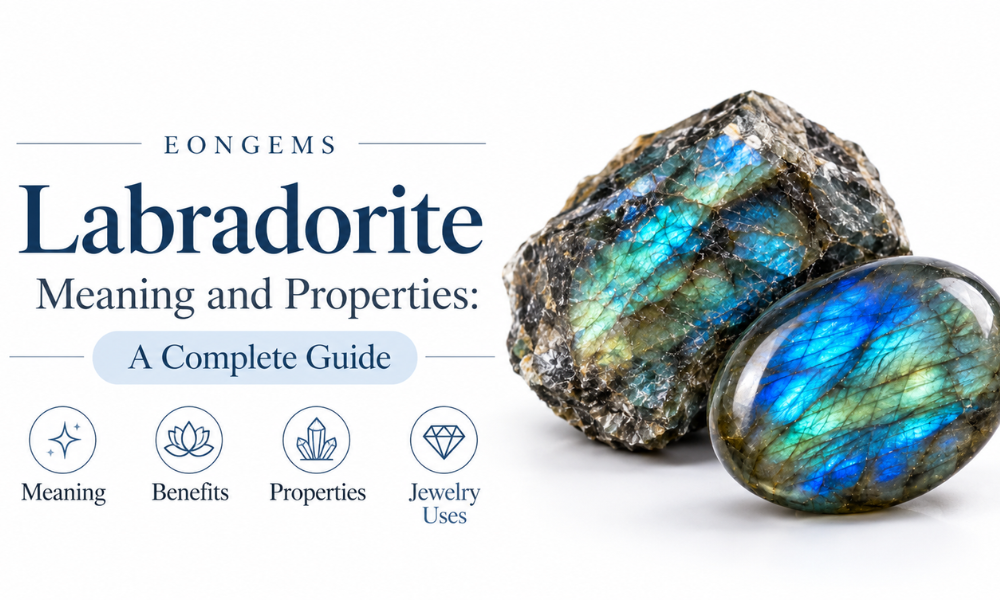
Labradorite meaning and properties are worth knowing before you buy or make a single piece. In dim light, this stone looks like plain grey rock. Tilt it, and a flash of blue, green, or gold appears out of nowhere.
That flash is why labradorite became a favorite in spiritual and bohemian jewelry. It’s also why people have told stories about it for centuries. This guide covers its history, its meaning in crystal healing, its physical properties, and how to use it in jewelry.
We’re Eon Gems, a Jaipur-based gemstone jewelry manufacturer with 36+ years of experience. Labradorite is one of the stones our bench sets most often, so this guide comes from daily work with it.
What Is Labradorite?
Labradorite is a feldspar mineral, part of the plagioclase family. Its body color is usually grey, dark grey, or nearly black. The magic happens inside the stone, not on the surface.
Labradorescence Explained
The colorful flash has its own name: labradorescence. Labradorite grows in thin, stacked layers. When light enters the stone, it bounces between those layers. Different layers bend different colors back to your eye.
That’s why the flash only shows from certain angles. Turn the stone a little, and the color disappears. Turn it back, and it returns. Blue is the most common flash. Green, gold, and orange are also common. Purple and red are rare.
Where Labradorite Comes From
Canada gave the stone its name. Madagascar is now a major source, along with Finland, India, Russia, and the United States. Madagascar stones often show strong blue and green flash. Indian material is widely available in calibrated sizes, which suits jewelry production well.
Labradorite Meaning and History
Labradorite has a short written history but a long list of stories.
The Inuit Legend
Moravian missionaries found the stone on the coast of Labrador in the late 1700s. Local Inuit people already knew it well. One legend says the Northern Lights once got trapped inside the rocks along the coast. A warrior freed most of the lights with his spear. Some stayed behind, and that’s the glow we see in labradorite today.
What Labradorite Means Today
Crystal healers call labradorite a stone of transformation and inner magic. People link it with intuition, protection, and change. It’s often connected to the zodiac signs Leo, Scorpio, and Sagittarius.
These meanings come from spiritual tradition, not science. Even so, they’re a big reason shoppers reach for labradorite.
Labradorite Metaphysical Properties
In crystal healing, labradorite has a reputation as a stone for people going through change. Here are the main ideas practitioners attach to it.
Intuition and Inner Vision
Labradorite is closely tied to intuition. Practitioners say it sharpens gut feelings and helps people trust their inner voice. Many people hold it during meditation or journaling for that reason.
Protection
Many healers describe labradorite as a shield for the energy field. They say it helps people stay grounded in crowded or stressful places. Empaths and highly sensitive people often wear it for this reason.
Transformation and Change
Labradorite’s changing flash fits its meaning. Healers connect it with new beginnings, career changes, and big life shifts. Its message is simple. Change can feel uncertain, but it can also be full of color.
Labradorite and the Chakras
Labradorite is mostly linked to the third eye chakra, which relates to intuition and insight. Some practitioners also connect it to the throat chakra, which relates to honest communication. A few add the crown chakra for spiritual awareness.
Labradorite Physical Properties
Now for the practical side. These details matter most to jewelers and buyers.
Hardness and Durability
Labradorite rates 6 to 6.5 on the Mohs hardness scale. That’s moderate. It handles light daily wear, but it scratches more easily than quartz or sapphire.
Cleavage
This is the catch. Labradorite has perfect cleavage in one direction and good cleavage in another. A hard knock can chip or split it. So rings and bracelets need protective settings. Pendants and earrings are safer choices.
Transparency and Color
Most labradorite is translucent to opaque. The body color ranges from light grey to nearly black. Cabochon cuts show the flash best. Faceted labradorite exists, but it’s much less common because faceting can hide the effect.
Varieties You’ll See
Spectrolite is a fine variety first found in Finland in the 1940s. It shows the full range of spectral colors across the surface. Black labradorite has a dark body that makes blue flash look extra bright. White labradorite, often sold as rainbow moonstone, has a pale body with a soft multicolor glow. It’s a trade name, not a separate mineral.
Treatments
Most labradorite is untreated. That’s a real selling point. Still, a few sellers sell dyed or coated stones, so disclosure matters. Always ask in writing.
Labradorite in Jewelry
Labradorite works for bohemian, minimalist, and artisan styles. It also photographs well, because the flash catches the light.
Best Cuts
Smooth cabochons are the standard. Oval and round shapes suit most designs. Freeform cabochons give each piece a one-of-a-kind look. Beads work well for bracelets and long necklaces.
Metal Pairings
925 sterling silver jewelry is the classic partner. The cool metal lets the blue and green flash stand out. Oxidized silver adds contrast and gives the stone a deeper, moodier look.
Gold vermeil jewelry brings out the golden flash. Yellow gold vermeil feels warm and rich against the grey body. Rose gold vermeil suits a softer, more romantic look.
Setting Tips
Because of the cleavage, bezel settings are the safest choice for rings. They wrap the stone’s edges in metal. Prong settings work for pendants and earrings, but they need good coverage. Freeform stones need custom bezels that follow their shape. And always choose stones with the flash centered, so it shows when the piece is worn.
Labradorite Price Guide
Labradorite is affordable compared with many gemstones. Price depends mostly on how strong and how colorful the flash is.
Commercial calibrated cabochons with a weak or single-color flash cost about $0.50 to $2 per stone. Good grade stones with a clear blue or green flash run $2 to $8. Fine stones with multicolor flash and a dark body can reach $10 to $50 or more. Rare spectrolite and large statement pieces cost more.
These ranges are approximate. Size, flash quality, and market conditions all change the numbers. Ask for photos of the stone in different light, because flash looks different from every angle.
How to Identify Real Labradorite
Imitations exist, so a few quick checks help.
Tilt the Stone
Real labradorite changes as you tilt it. The flash appears and disappears. Glass imitations often show the same color from every angle.
Look for Natural Variation
Natural stones show slight color differences and tiny surface lines. Two real stones never match exactly. Perfect, even flash across a whole batch is a warning sign.
Watch for Coatings
Some cheap stones get a thin color coating on the surface. That coating can scratch off. If the flash looks flat or sits only on top of the stone, ask questions.
Ask for Documentation
A reputable supplier will state the stone’s origin type and treatment status on the invoice. At Eon Gems, we disclose treatments on every gemstone order. The GIA Gem Encyclopedia is a good place to learn more about feldspar gems and disclosure standards.
How to Care for Labradorite
Labradorite is easy to look after, as long as you treat it gently.
Cleaning
Wipe it with a soft, damp cloth. For dirtier pieces, use mild soap and lukewarm water, then dry right away. Skip ultrasonic and steam cleaners. Vibration and heat can damage the stone along its cleavage planes.
Wearing and Storage
Take labradorite rings off before sports, gardening, or heavy work. Store each piece in its own soft pouch, because harder gems can scratch it. Also keep it away from harsh chemicals and long soaks.
Sourcing Labradorite for Jewelry Brands
If you’re building a labradorite collection, a few choices save you trouble later.
Pick stones with the flash centered and visible from the front. Order calibrated sizes for consistency. Ask for stones from one parcel, so color and flash match across a batch. And request samples before bulk orders, since flash is hard to judge from photos alone.
Jaipur is the world’s largest colored gemstone trading hub. That means wide choice and direct sourcing, which helps both quality and price.
Frequently Asked Questions
What is labradorite meaning in crystal healing?
Labradorite stands for transformation, intuition, and protection. Healers call it a stone for people going through change. They also link it with inner vision and a calm, steady mind.
Which chakra does labradorite work with?
Mostly the third eye chakra, which relates to intuition. Some practitioners also use it with the throat and crown chakras.
Can I wear labradorite every day?
Yes, with care. Pendants and earrings are the best choices for daily wear. Rings need bezel settings and some caution, because the stone can chip if it’s knocked hard.
Is labradorite the same as moonstone?
No. Both are feldspar minerals, but they’re different stones. Moonstone shows a soft blue glow called adularescence. Labradorite shows a sharper, more colorful flash. The “rainbow moonstone” sold in shops is actually white labradorite.
Does labradorite fade or lose its flash?
Natural flash doesn’t fade. A coated imitation can lose its color, though. If the flash disappears over time, the stone was probably coated.
What metal looks best with labradorite?
Sterling silver gives a cool, clean look that makes blue flash pop. Yellow gold vermeil highlights golden flash. Both work well, so the choice depends on your brand’s style.
Eon Gems: Labradorite Jewelry Manufacturer in Jaipur
Labradorite is part of our regular gemstone jewelry manufacturing range. We’re based in Jaipur and buy directly from established traders. We disclose every treatment, and we match stones carefully for color and flash.
What we offer labradorite jewelry brands:
- Natural labradorite in round, oval, and freeform cabochons
- Black labradorite and rainbow flash varieties
- Settings in 925 sterling silver and gold vermeil
- Bezel and freeform settings made for the stone’s cleavage
- Full treatment disclosure on every stone
- No MOQ, from a single prototype to large bulk orders
- Complete export documentation for all major markets
👉 Get a Free Quote from Eon Gems →
🔗 Gemstone Jewelry Manufacturing →
🔗 925 Sterling Silver Jewelry →
🔗 Gold Vermeil Jewelry →