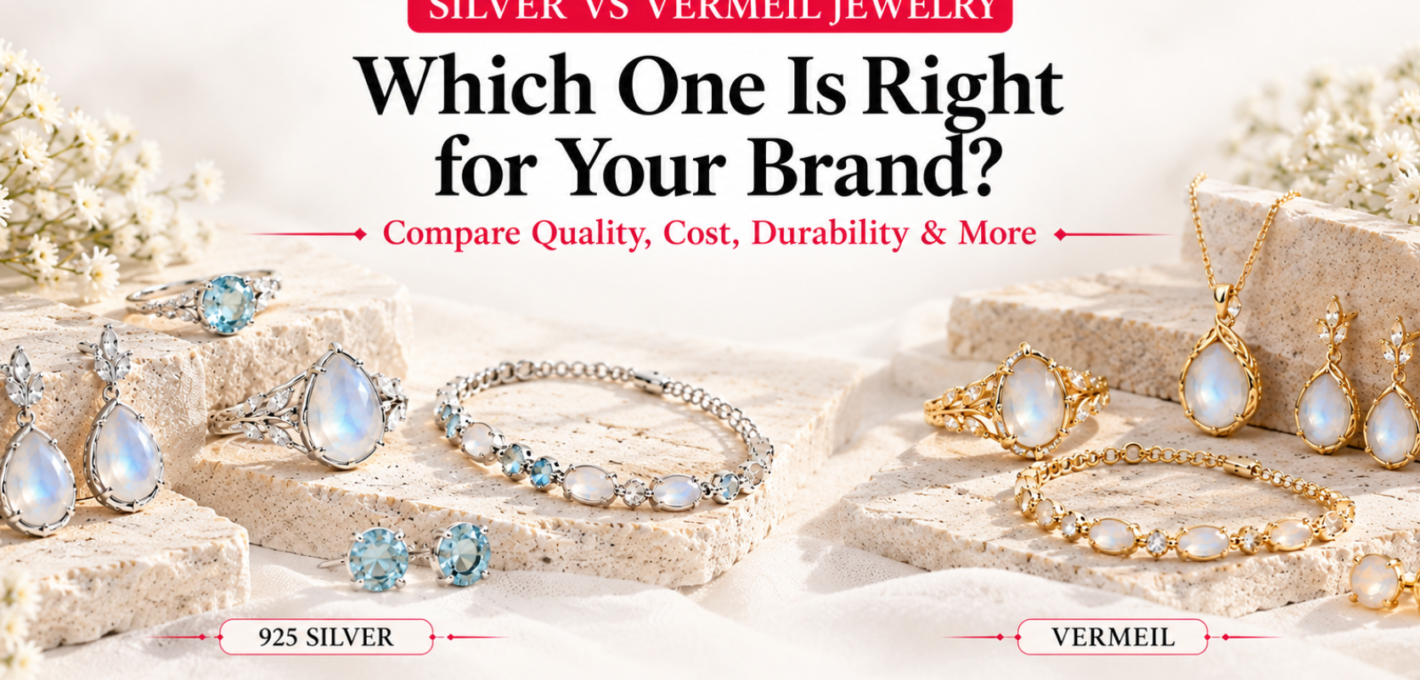
Two of the most popular choices for jewelry brands — but which one actually makes more sense for your specific business? This guide breaks it all down so you can make a clear, confident decision.
When you’re building a jewelry brand, one of the most consequential early decisions is your core material. It affects your manufacturing cost, your retail price, your target customer, your brand positioning — and ultimately, your margins. The debate between 925 sterling silver and gold vermeil comes up constantly among brand founders, and for good reason: both are legitimate, quality materials with very different business implications.
Choosing between Silver vs Gold Vermeil is one of the biggest decisions for any jewelry brand. Both materials offer unique advantages in pricing, durability, branding, and customer appeal. Understanding the difference between sterling silver and gold vermeil helps businesses choose the right material for their target audience and pricing strategy.
Here’s the complete, honest breakdown.
First — What Exactly Are We Comparing?
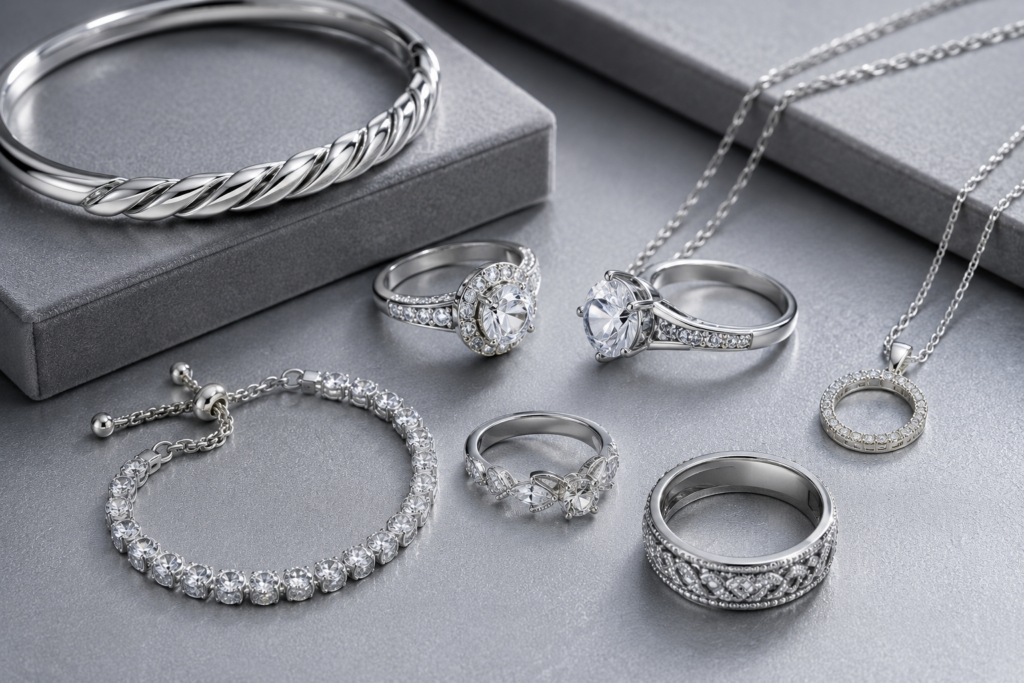
925 Sterling Silver
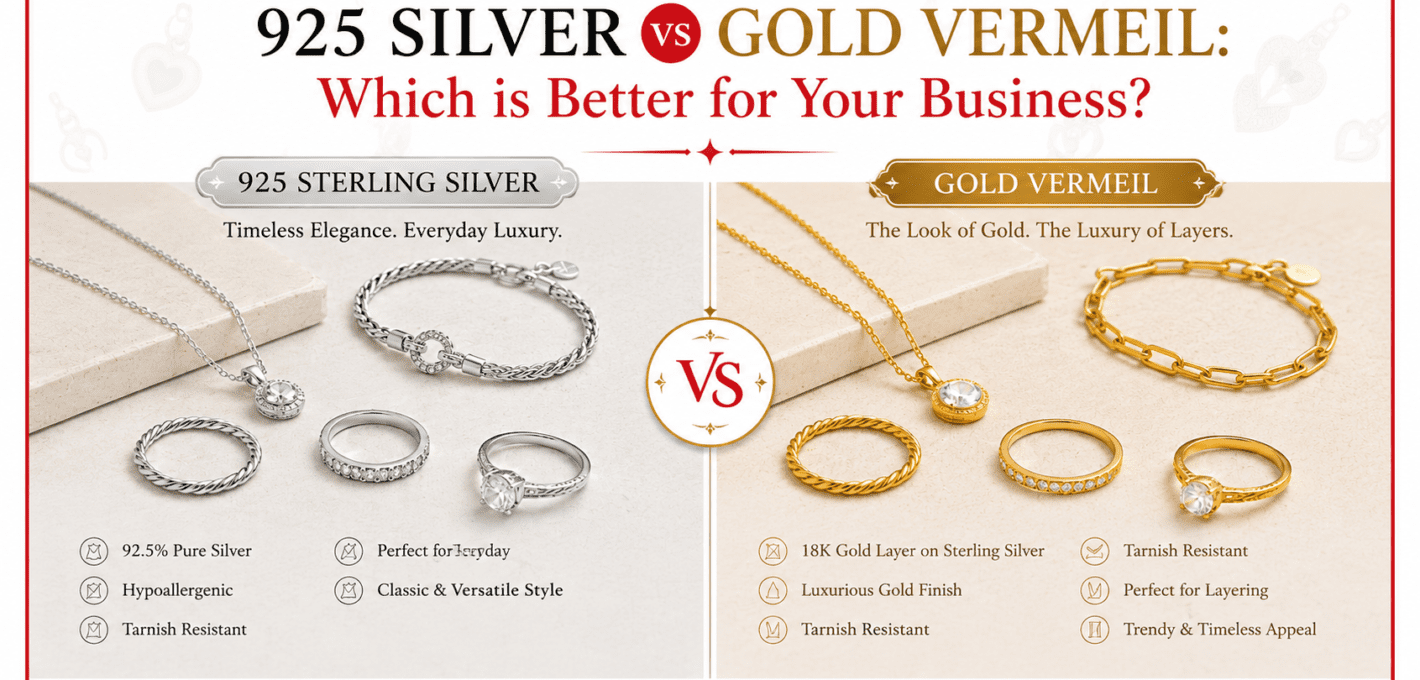
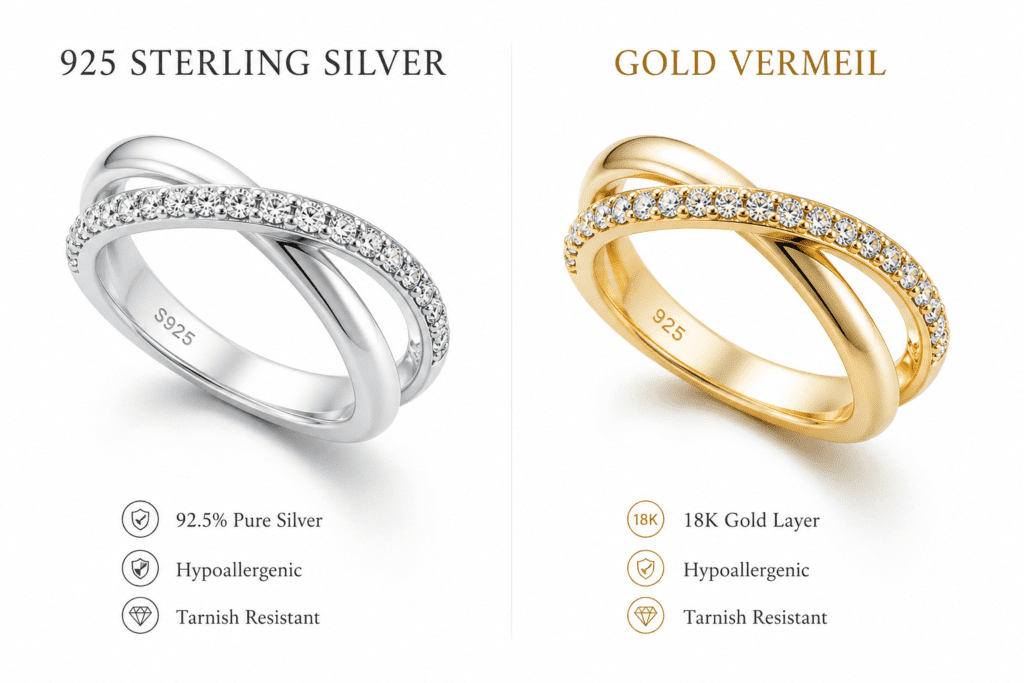
An alloy of 92.5% pure silver and 7.5% other metals (usually copper) for added strength. The “925” hallmark guarantees this ratio. A precious metal in its own right — not a base metal or plating. Naturally white-grey in colour with a cool, bright finish.
Gold Vermeil
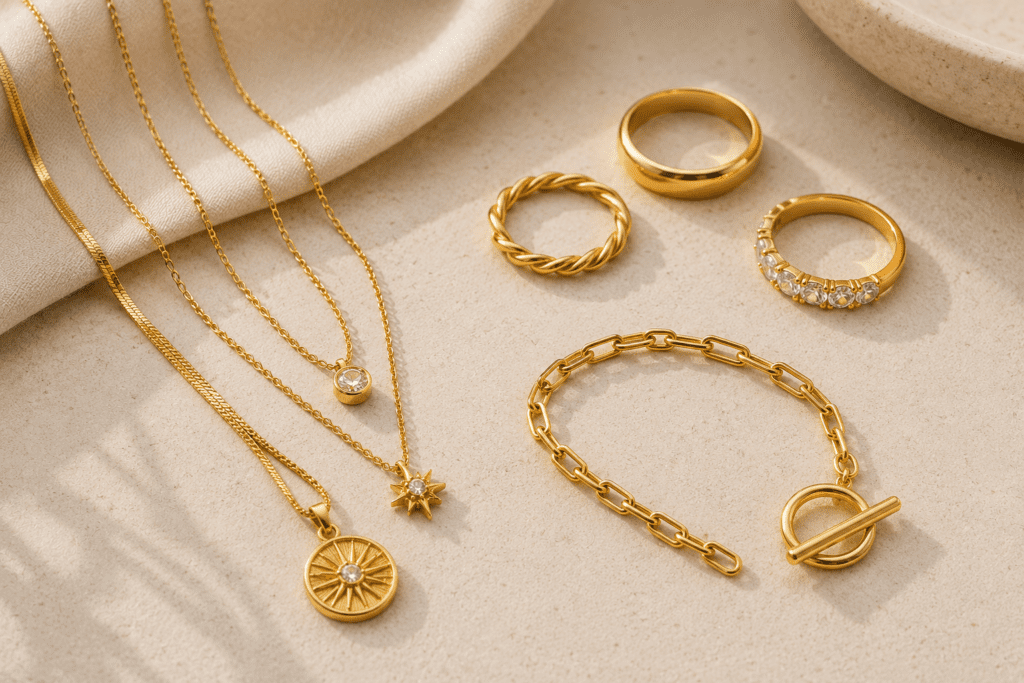
925 sterling silver with a real gold layer applied through electroplating. To qualify as true vermeil: the base must be sterling silver, the gold must be at least 10 karat, and the plating must be at least 2.5 microns thick. The result looks and feels like solid gold jewelry at a fraction of the price.
Note that gold vermeil is built on 925 silver — so in a sense, every vermeil piece starts as a silver piece. The question is really about whether the gold finish adds enough value for your business to justify the extra step and cost.
Cost Comparison: Manufacturing and Material
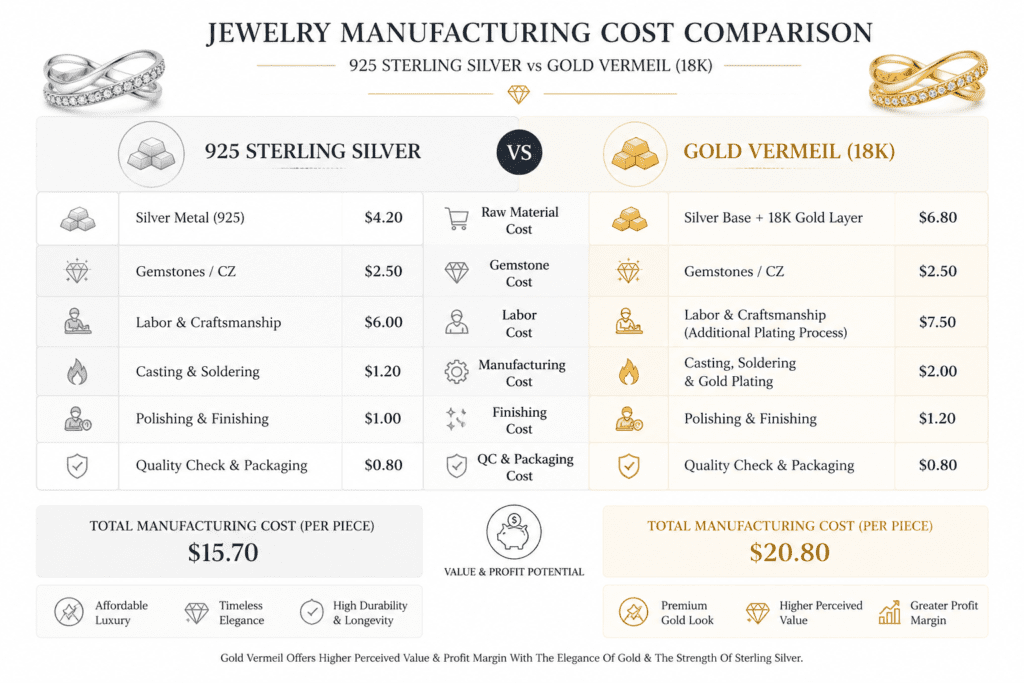
Let’s talk numbers. For a typical ring or pendant manufactured in Jaipur:
- 925 silver piece — lower raw material cost, simpler production process, faster turnaround
- Gold vermeil piece — same silver base cost, plus the electroplating process and the gold used in plating. Typically adds 15–35% to the manufacturing cost depending on plating thickness (2.5 to 5 microns) and karat (14k vs 18k)
At retail, however, vermeil pieces command significantly higher prices. A silver ring that retails for ₹2,500 or $30 can be positioned as a vermeil ring at ₹5,000–₹8,000 or $60–$120 — with the same base manufacturing complexity. The margin math often favours vermeil once you account for retail positioning.
Eon Gems’ sterling silver jewelry manufacturing and gold vermeil manufacturing are both available with no minimum order quantity — which means you can test both materials in small batches before committing to either at scale.
Side-by-Side Comparison
Which Customer Are You Selling To?
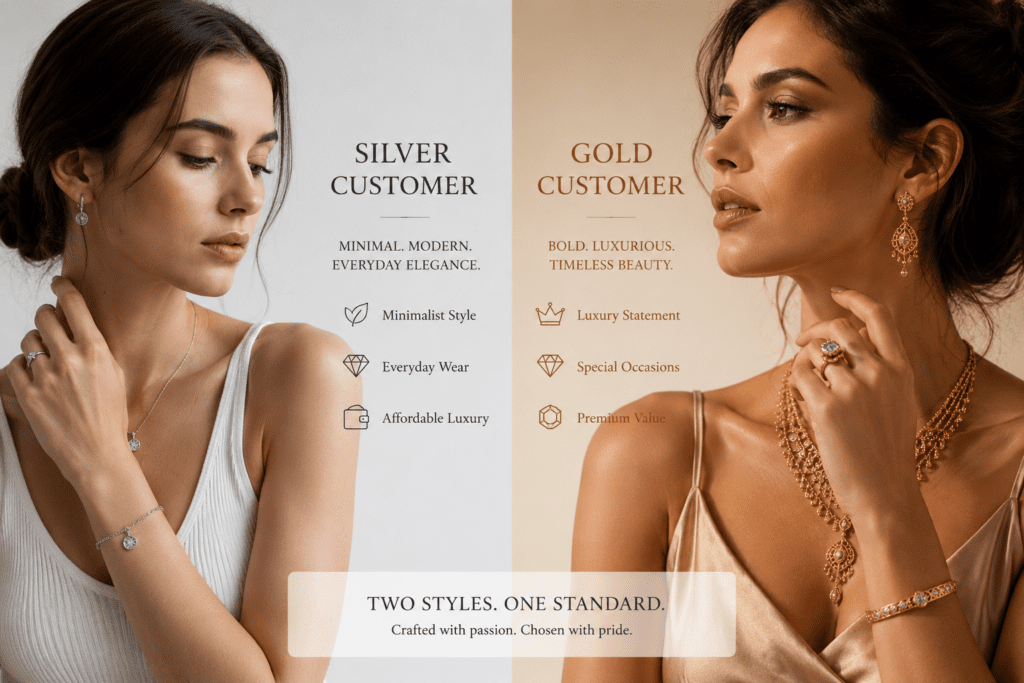
This is the most important question — and it’s one that raw cost comparisons can’t answer for you.
925 Silver is the stronger choice if your customer:
- Values cool-toned, minimalist, or artisan aesthetics
- Shops in the ₹1,500–₹5,000 / $20–$80 price range
- Buys jewelry as everyday wear, not occasional or gift-driven
- Is in markets like Scandinavia, Japan, or the UK where silver jewelry has strong cultural cachet
- Prefers a finish that lasts indefinitely without replating
Gold Vermeil is the stronger choice if your customer:
- Wants the look of gold without the price of solid gold
- Shops in the ₹4,000–₹20,000 / $60–$300 price range
- Buys jewelry for gifting, occasions, or as a personal treat
- Is in markets like the US, Australia, or the Middle East where gold-tone jewelry dominates
- Responds to the word “gold” as a signal of quality and value
Durability: The Honest Truth
This is where most brand founders make an error — assuming vermeil is less durable and therefore a weaker product choice. The reality is more nuanced.
925 silver has a permanent finish that doesn’t wear off — but it tarnishes. Exposure to air, moisture, perfume, and sweat causes silver to oxidise and darken over time. This is manageable with polishing, but it requires customer education and occasional maintenance.
Gold vermeil at 2.5 microns or above resists tarnish well (the gold layer protects the silver beneath) and maintains its colour longer than most customers expect. At 3–5 microns, a well-cared-for vermeil piece can look excellent for 2–4 years. And when it does eventually wear — it can be replated, essentially restoring it to new. No other material category offers this kind of product lifecycle management.
The key is plating thickness. Always specify 2.5 microns minimum — and 3+ microns for rings and bracelets that take the most daily wear.
Gemstones: Does the Choice of Metal Matter?
Good news — your gemstone options are essentially identical across both materials. Whether you’re working with:
- Natural gemstones — sapphires, emeralds, turquoise, amethyst, labradorite
- Lab-grown or substitute stones — for colour consistency and price efficiency
- Pearls — freshwater, baroque, or Edison pearls
- Lab-grown diamonds — for brands wanting diamond pieces without natural diamond pricing
…all of these set equally well into 925 silver or gold vermeil bases. The stone doesn’t know or care what metal it’s sitting in. What changes is the visual pairing — warm stones (garnet, citrine, morganite) tend to photograph more beautifully against a gold vermeil base, while cool stones (aquamarine, blue topaz, moonstone) often look more striking against silver.
Brand Positioning: The Strategic Angle
Beyond the product itself, think about what each material signals to your audience.
925 silver signals: artisan, authentic, wearable, modern minimalism. Brands like Pandora and Georg Jensen have built enormous businesses on this positioning.
Gold vermeil signals: luxury, warmth, occasion, gifting. It allows smaller brands to compete visually with solid gold jewelry brands at a price point that retains healthy margins.
Many successful jewelry brands actually offer both — a silver line for everyday buyers and a vermeil line for premium or gifting occasions. This dual-range strategy maximises your addressable customer base without requiring two entirely separate manufacturing setups.
Our Verdict
Start with silver if you’re testing the market, working with a tight budget, targeting everyday wear, or building around artisan or minimalist aesthetics.
Start with vermeil if you want higher retail prices, you’re targeting gifting or occasion markets, or your brand is positioned in the accessible luxury space.
Ideally — offer both. Silver gives you volume and accessibility. Vermeil gives you margin and aspiration. Together, they cover the full spectrum of what most jewelry buyers are looking for.
Working With a Manufacturer for Both
The smartest thing you can do when testing silver vs vermeil is work with a manufacturer who can produce both — so you’re not managing two separate supplier relationships while you figure out what your market responds to.
Eon Gems, based in Jaipur, manufactures both 925 silver and gold vermeil with no minimum order quantity. With over 31 years of experience and clients across the US, UK, and Australia, they understand what international jewelry brands need — fast sampling, flexible quantities, and a manufacturing partner who communicates clearly throughout the process.
If you’re at the stage of deciding between these two materials for your brand, reaching out for samples of the same design in both silver and vermeil is the most practical way to make the decision. Seeing and feeling the difference in your hand — and in product photography — tells you far more than any comparison table.