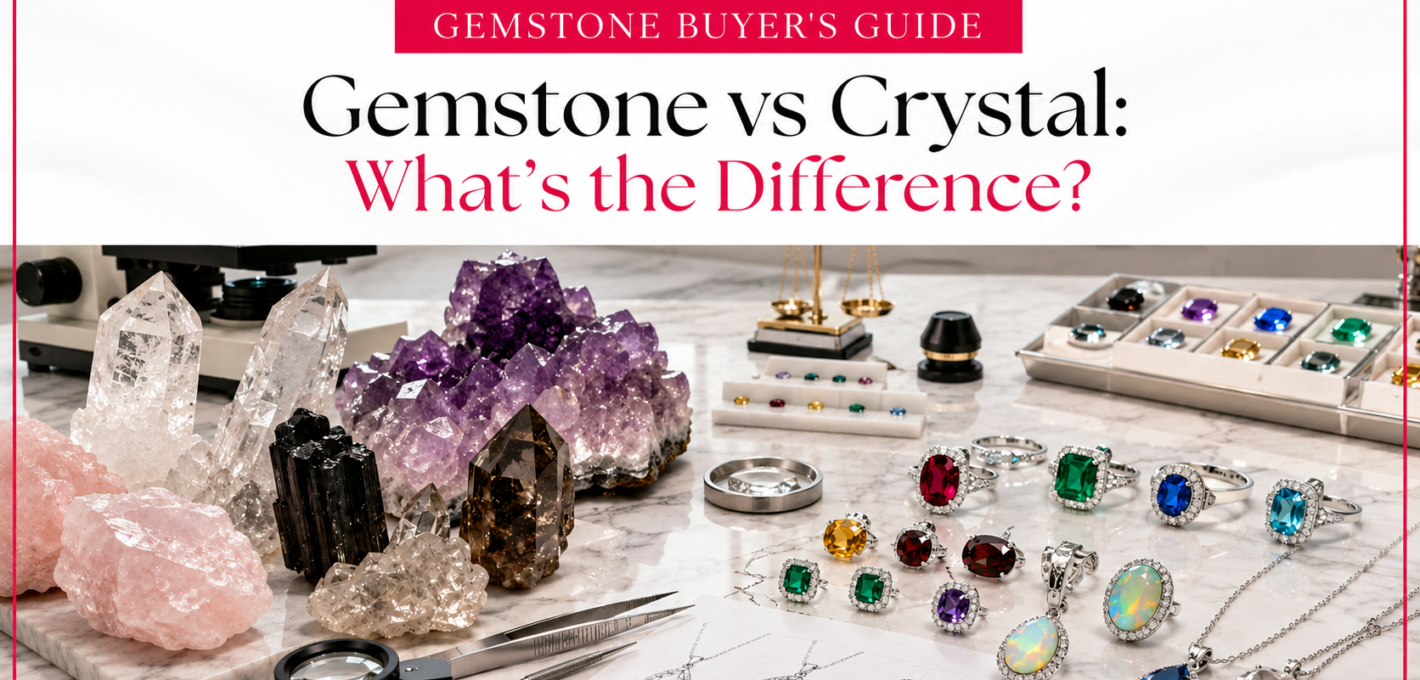
Walk into any jewelry store, scroll through any gemstone marketplace, or browse any spiritual wellness brand — and you will find the terms “gemstone” and “crystal” used everywhere, often interchangeably. Are they the same thing? Are they different? And does the distinction actually matter when you are buying or sourcing jewelry?
The answer is nuanced — and understanding it makes you a significantly more informed buyer. At Eon Gems, we have been sourcing, cutting, and setting natural stones for 36+ years as one of Jaipur’s most established gemstone jewelry manufacturers. Here is the complete guide.
The Scientific Definition — What Is a Crystal?
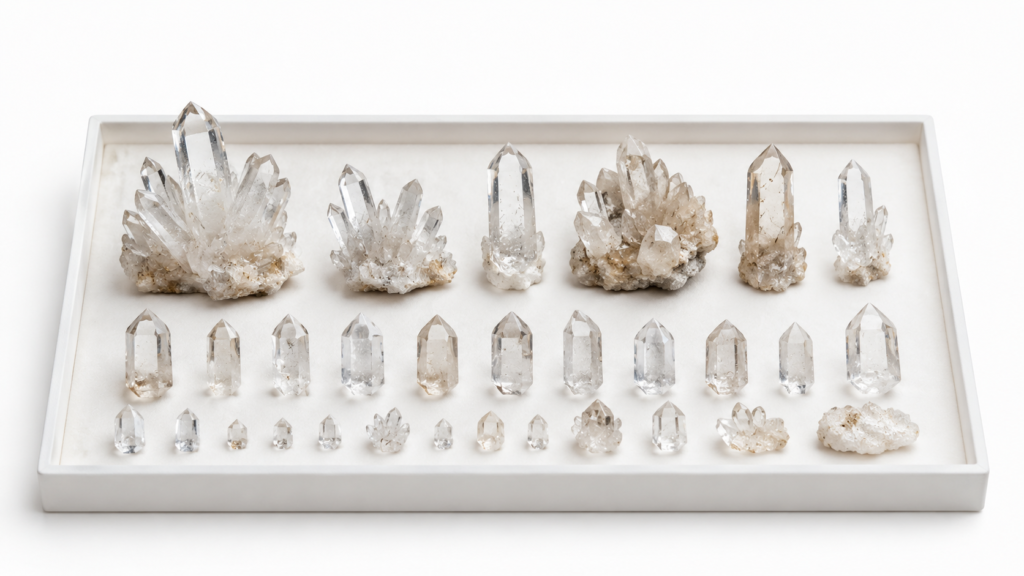
In scientific terms, a crystal is any solid material in which the atoms, molecules, or ions are arranged in a highly ordered, repeating pattern extending in all three dimensions. This ordered internal structure is called a crystalline structure — and it is what gives crystals their characteristic geometric shapes, flat faces, and precise angles when they form naturally.
Almost all minerals form crystals when they grow under the right conditions. The word “crystal” refers to this internal atomic arrangement — not to any specific type of stone.
This means that in scientific language:
- Quartz is a crystal
- Diamond is a crystal
- Ruby is a crystal
- Emerald is a crystal
- Salt is a crystal
- Ice is a crystal
Crystal structure is a property of how atoms arrange themselves — it is not a quality grade, a spiritual category, or a marketing term.
The Scientific Definition — What Is a Gemstone?
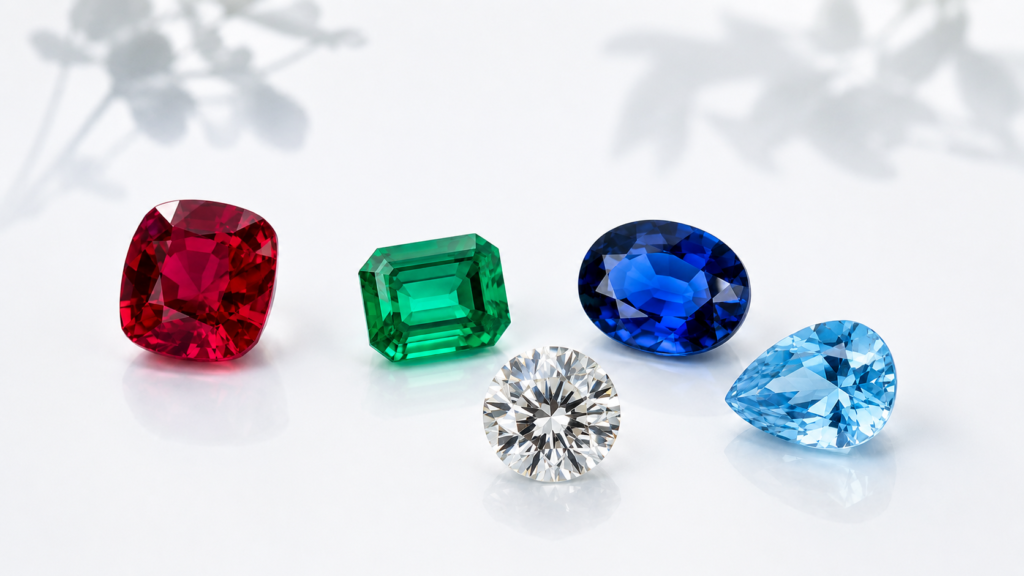
A gemstone is a mineral, rock, or organic material that is considered valuable or desirable enough to be cut, polished, and used in jewelry or decorative objects.
Three qualities typically define a gemstone:
Beauty: The stone must be visually appealing — whether through color, brilliance, optical effects, or unique appearance.
Durability: The stone must be hard and tough enough to survive being worn in jewelry without easy damage. Gemologists use the Mohs hardness scale (1–10) to assess this.
Rarity: Stones that are harder to find command higher value. Rarity — whether natural geological rarity or the rarity of specific quality grades — is central to gemstone valuation.
The key point: Almost all gemstones are crystals — they have an ordered internal atomic structure. But not all crystals are gemstones — many crystalline minerals are too common, too soft, or too unattractive to qualify as gemstones.
Gemstone vs Crystal — What Is the Real Difference?
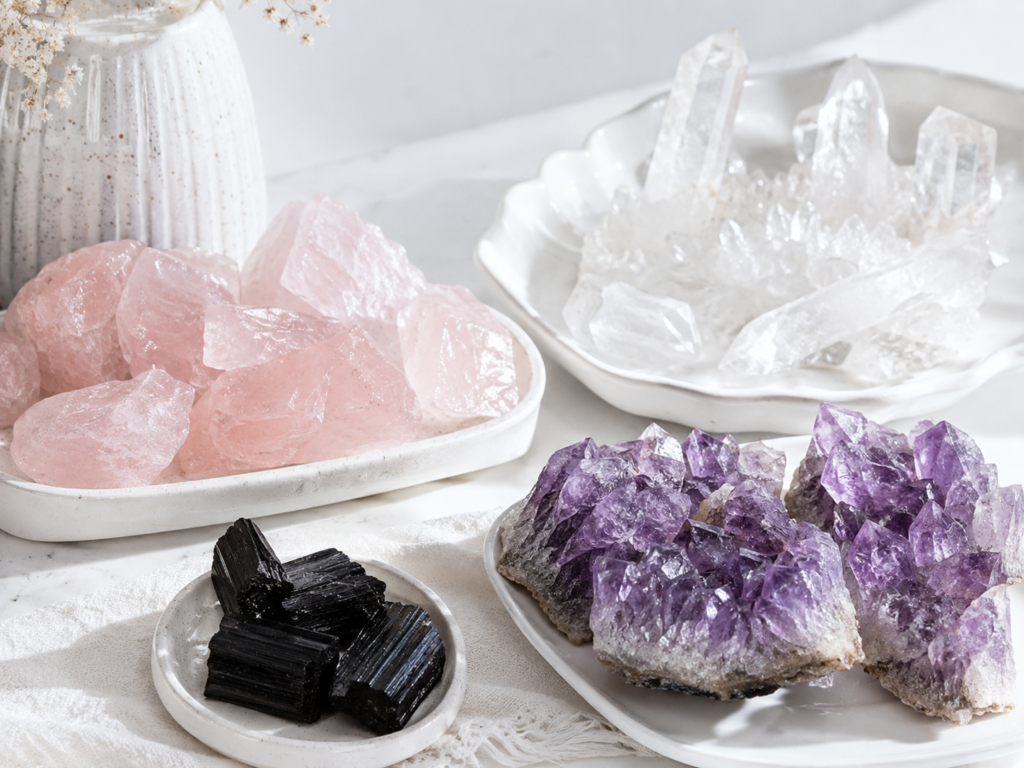
The distinction is one of scope and context rather than fundamental opposition:
Crystal is the broader scientific term — referring to the internal atomic structure of a solid material. It applies to minerals, ice, metals, and many other materials.
Gemstone is the applied, commercial, and aesthetic term — referring specifically to minerals and materials that are beautiful, durable, and valuable enough to use in jewelry and decorative art.
In practical terms:
- A rough piece of amethyst sitting in the ground is a crystal — referring to its internal structure
- That same amethyst, cut and polished and set into a ring, is a gemstone — referring to its status as a valued, wearable material
Most gemstones are crystals. But the word “crystal” alone does not imply gemstone quality, gemstone value, or suitability for jewelry.
How the Terms Are Used in Different Industries
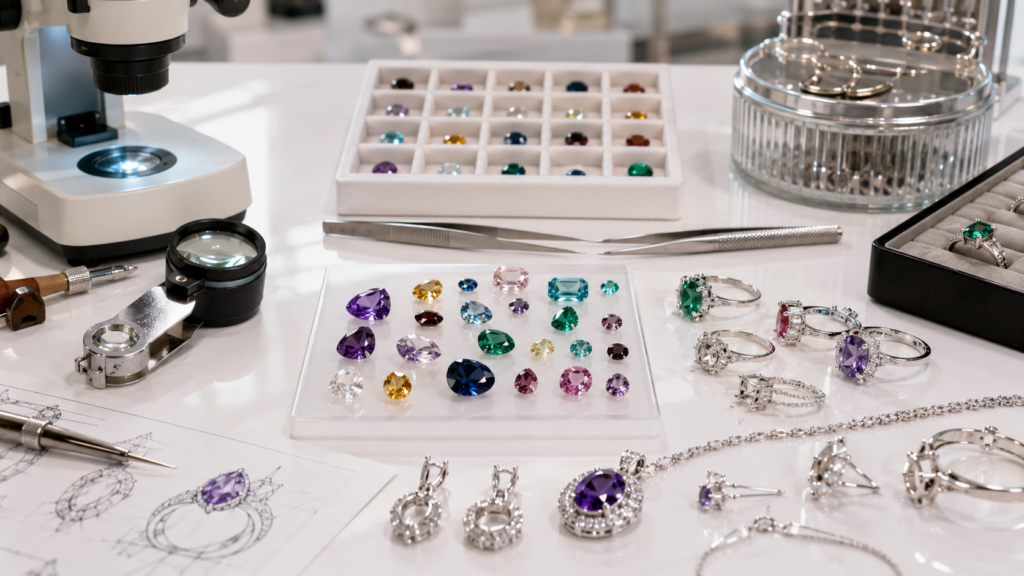
Understanding how these terms are applied in commercial and cultural contexts helps explain why the confusion exists in the first place.
In the Jewelry Industry
Professional jewelers and gemologists use the term gemstone almost exclusively — referring to the specific minerals and organic materials used in fine and fashion jewelry. When a jeweler says “gemstone,” they mean a stone that has been selected, graded, cut, and polished for use in jewelry based on its beauty and durability.
At Eon Gems, our gemstone manufacturing operation covers 250+ varieties of natural and lab-grown stones — all selected specifically for their suitability as jewelry gemstones based on color, clarity, cut, and durability.
In the Spiritual and Wellness Industry
The word crystal is widely used in the spiritual and wellness community to refer to stones believed to carry specific energies, healing properties, or metaphysical significance — rose quartz, amethyst, black tourmaline, selenite, and many others.
In this context, “crystal” is not a scientific term — it is a cultural and spiritual designation. Many of the stones referred to as “crystals” in wellness culture are genuine gemstones in the jewelry industry’s definition — amethyst, for example, is both a crystal (scientifically) and a gemstone (in jewelry terms) and a healing crystal (in wellness terms).
In Consumer Retail
Many retail sellers use “crystal” and “gemstone” interchangeably — sometimes to describe genuine natural stones, and sometimes to describe synthetic glass or man-made materials like Swarovski crystal, which is actually lead crystal glass rather than a natural mineral at all.
This is where the confusion most frequently causes problems for buyers — particularly online, where product descriptions may be vague or misleading.
Are Crystals Used in Jewelry?
Yes — many of the most popular gemstones used in jewelry are also crystals in the scientific sense. Here are some commonly used jewelry stones and their crystal system:
Quartz family — Hexagonal crystal system:
Amethyst, citrine, rose quartz, smoky quartz, rock crystal — all varieties of quartz, all crystalline, all widely used in jewelry.
Corundum family — Trigonal crystal system:
Ruby and sapphire — both varieties of corundum, both crystalline, both among the most valued gemstones in the world.
Beryl family — Hexagonal crystal system:
Emerald, aquamarine, morganite — all beryl varieties, all crystalline.
Garnet — Cubic crystal system:
All garnet varieties are crystalline and widely used in jewelry.
Diamond — Cubic crystal system:
The most famous crystal structure in jewelry — diamond’s cubic arrangement is responsible for its extraordinary hardness.
What About Non-Crystalline Gemstones?
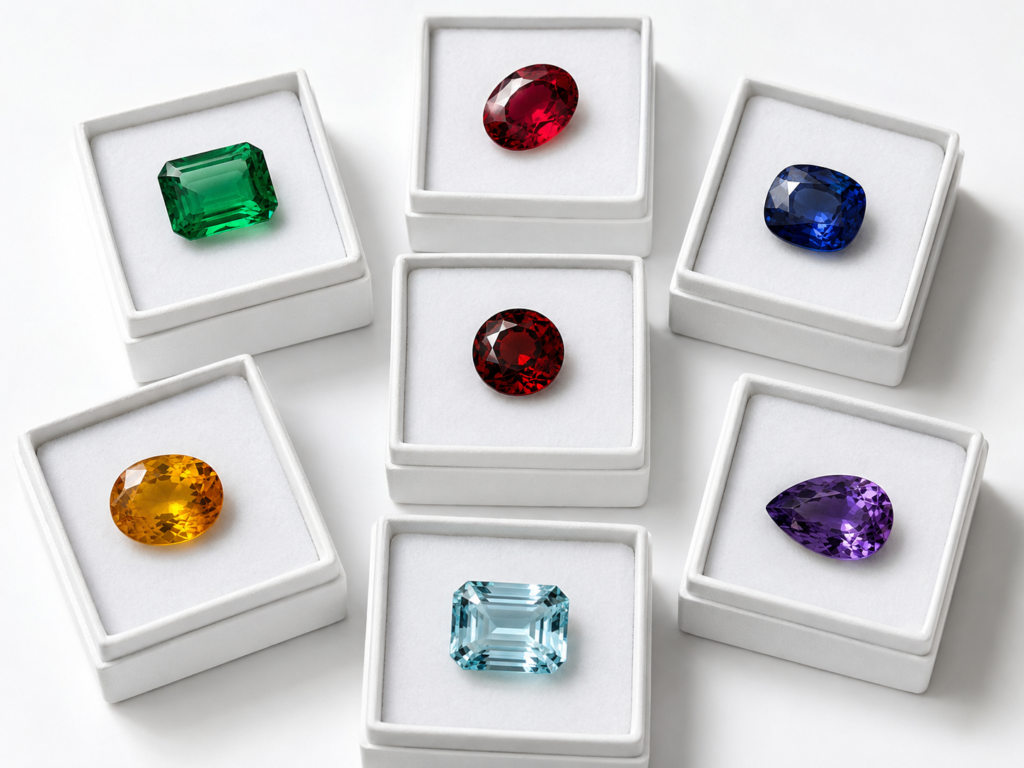
Not all gemstones are crystalline. Some of the most popular stones used in jewelry have an amorphous internal structure — meaning their atoms are arranged randomly rather than in a regular repeating pattern.
Opal: One of the most visually spectacular gemstones — its famous play of color comes from its unique amorphous silica structure rather than a crystalline arrangement. Ethiopian opal, in particular, is one of the most popular stones in Eon Gems‘ gemstone jewelry manufacturing range.
Obsidian: Volcanic glass — entirely amorphous, used in some jewelry and spiritual wellness contexts.
Amber: Fossilized tree resin — organic, amorphous, and technically not a mineral at all, but classified as a gemstone due to its beauty and use in jewelry.
Pearl: Organic material produced by mollusks — amorphous aragonite and conchiolin, not crystalline in the gemstone sense.
These non-crystalline gemstones demonstrate that the gemstone category is defined by beauty, durability, and value — not by crystal structure.
Swarovski Crystal — Gemstone or Crystal?
This is one of the most common sources of consumer confusion in jewelry retail.
Swarovski crystal is not a natural mineral. It is a form of precision-cut lead crystal glass — manufactured by the Austrian company Swarovski to extremely precise optical standards, producing high brilliance and fire that mimics gemstones.
It is neither a gemstone (not a natural mineral used for its inherent beauty and rarity) nor a crystal in the geological sense (not a naturally occurring mineral with an ordered atomic structure).
Swarovski crystal is a manufactured glass product — very beautiful and useful in fashion jewelry, but fundamentally different from natural gemstones. This distinction matters particularly for brands that need to accurately represent their products to comply with FTC and trading standards requirements in major markets.
What Does This Mean for Jewelry Buyers?
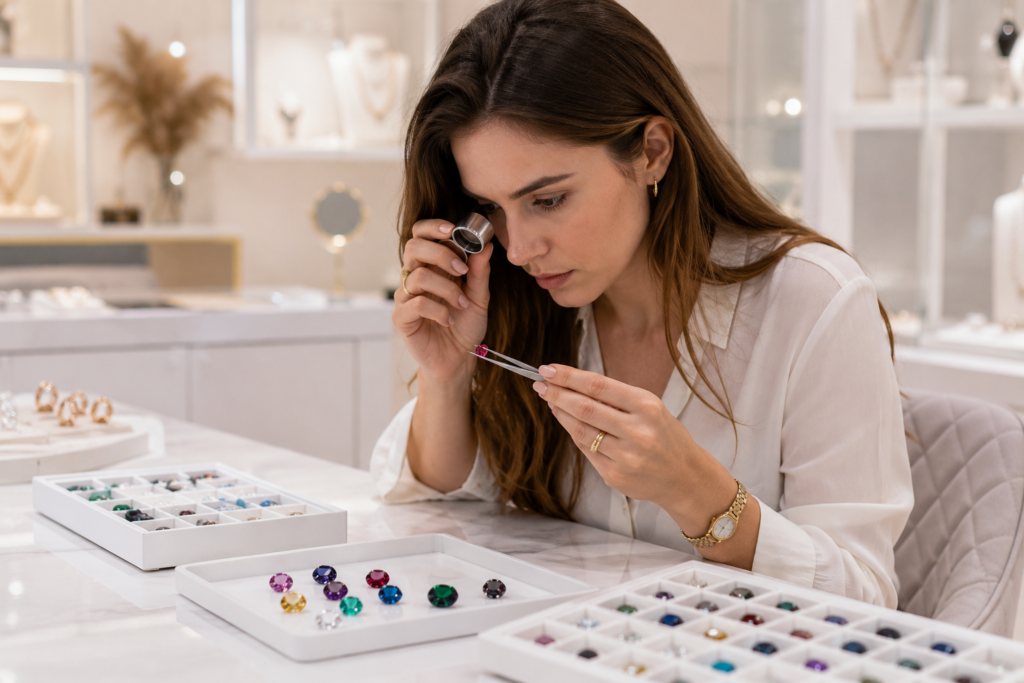
For individual buyers, understanding the gemstone vs. crystal distinction helps you make more informed purchasing decisions:
When buying “crystal jewelry”: Clarify whether the stones are natural minerals or manufactured glass. Both can be beautiful — but they have very different value propositions, care requirements, and price points.
When buying “gemstone jewelry”: Look for specifics — what stone, what treatment status, what quality grade? A “gemstone pendant” could mean anything from a $2 synthetic stone to a $500 natural sapphire. The more specific the description, the more trustworthy the seller.
When buying “healing crystals”: Understand that the wellness industry’s use of “crystal” is a cultural designation, not a quality certification. Many genuine natural gemstones are sold in this context — amethyst, rose quartz, labradorite — but the term alone does not guarantee natural origin, quality, or value.
What Does This Mean for Jewelry Brands?
For jewelry brands and wholesale buyers, the distinction carries compliance implications:
Accurate material description is a legal requirement in most major markets. Describing a manufactured glass product as a “gemstone” is misrepresentation. Describing a synthetic lab-created stone as “natural” is fraud.
FTC guidelines (USA) require clear disclosure of lab-grown status and any treatments applied to gemstones. Ambiguous language like “crystal” used to describe synthetic glass or lab-created stones without disclosure does not meet these standards.
Best practice: Always specify the exact stone name, whether it is natural or lab-grown, and any known treatments in your product descriptions and documentation.
At Eon Gems, every stone we supply — natural or lab-grown — is clearly documented on invoices and certificates with accurate species identification and treatment disclosure. Our 925 sterling silver and gold vermeil jewelry is always described with precise stone identification — because transparency about materials is fundamental to the trust we build with our B2B clients.
Common Gemstones vs. Their Crystal Classification
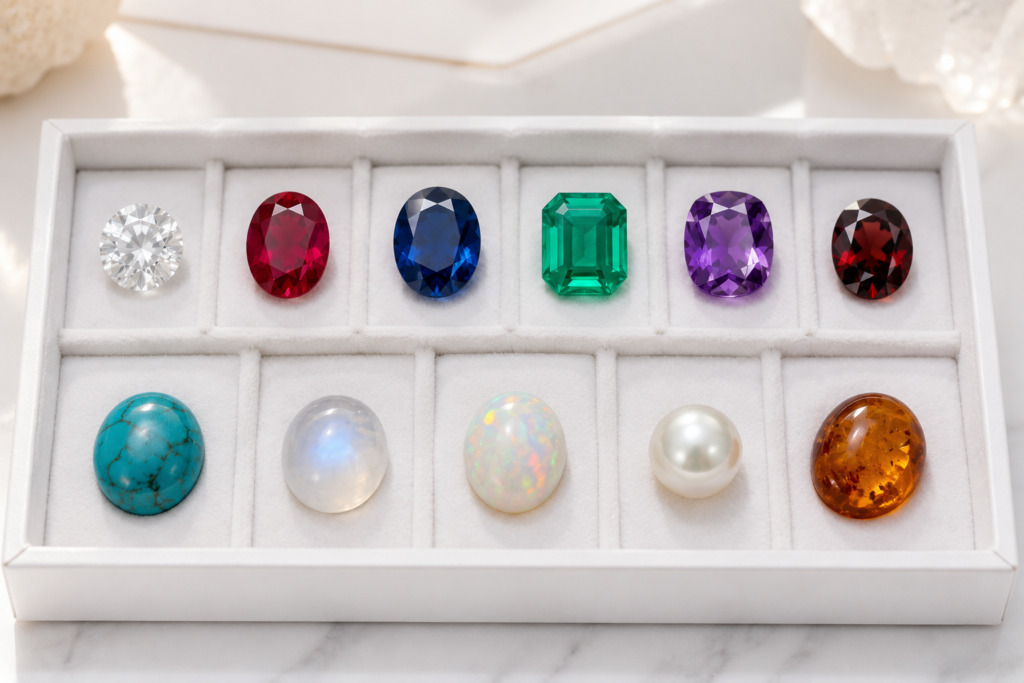
FAQs — Gemstone vs Crystal
Is a gemstone always a crystal?
No — some gemstones, including opal, pearl, and amber, are amorphous rather than crystalline. However, the vast majority of gemstones used in jewelry do have a crystalline internal structure.
Is a crystal always a gemstone?
No — crystal refers to atomic structure, not value or beauty. Many crystalline minerals are too common, too soft, or too unattractive to qualify as gemstones. Salt, ice, and many common rocks are crystalline but are not gemstones.
Are healing crystals real gemstones?
Many are — amethyst, rose quartz, labradorite, black tourmaline, and many other stones sold in the wellness market are genuine natural minerals. However, the term “healing crystal” is a cultural designation, not a quality certification. Always verify the specific stone identity when purchasing.
Is Swarovski crystal a real gemstone?
No — Swarovski crystal is precision-cut lead crystal glass, not a natural mineral. It is beautiful and useful in fashion jewelry but is not a gemstone and should not be represented as one.
Can lab-grown stones be called gemstones?
Yes — lab-grown ruby, sapphire, and emerald are chemically and physically identical to their natural counterparts and are genuinely classified as gemstones. They must be disclosed as lab-grown, but the gemstone designation is accurate.
Eon Gems — Natural Gemstone Jewelry Manufacturer in Jaipur
At Eon Gems, we work exclusively with accurately identified, properly disclosed natural and lab-grown gemstones — set into custom 925 sterling silver and gold vermeil jewelry for wholesale buyers and jewelry brands worldwide.
With 36+ years of gemstone sourcing and manufacturing experience in Jaipur — the world’s largest colored gemstone trading hub — we offer:
- 250+ natural gemstone varieties — sourced directly, conflict-free
- Lab-grown options — ruby, sapphire, emerald, moissanite, and alexandrite
- Complete treatment disclosure on every stone as standard
- All setting types — prong, bezel, pavé, channel, and freeform
- Full integration with our silver and vermeil manufacturing
- No MOQ — single prototype to large bulk production
👉 Get in touch with Eon Gems →
🔗 Gemstone Jewelry Manufacturing →
🔗 925 Sterling Silver Jewelry →
🔗 Gold Vermeil Jewelry →