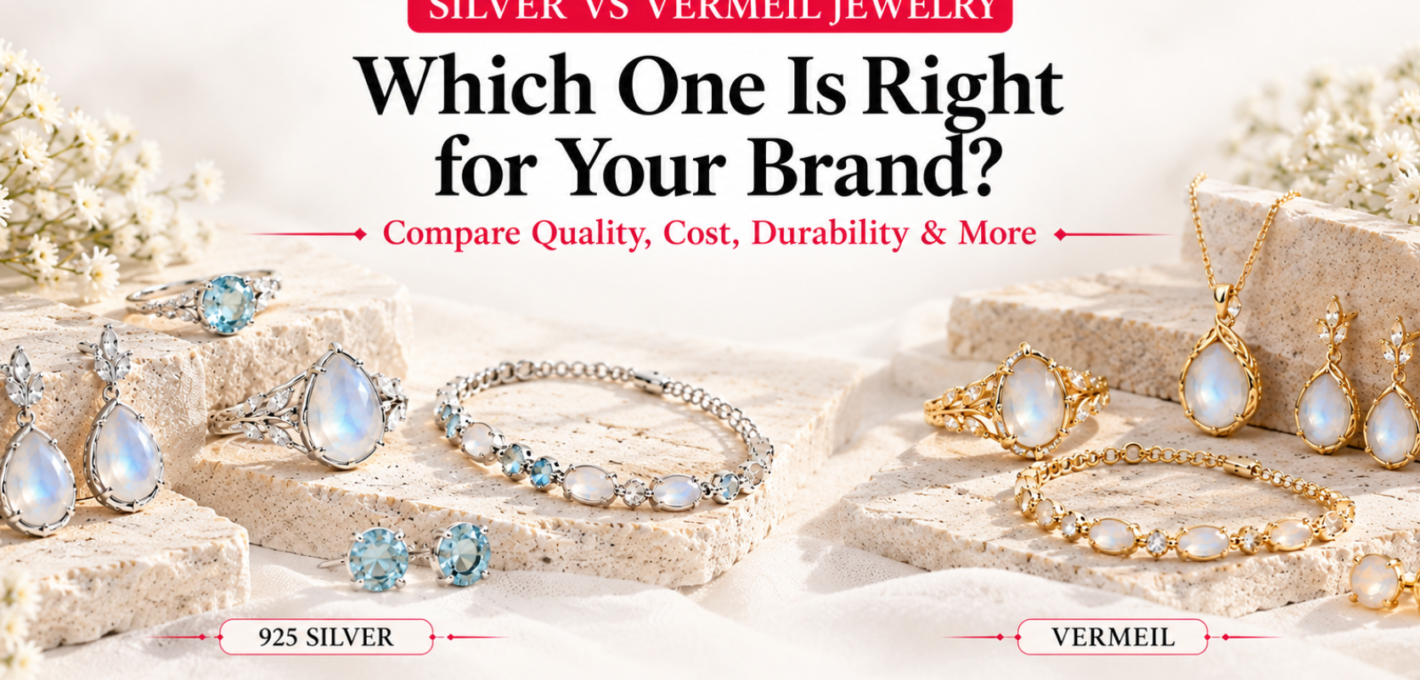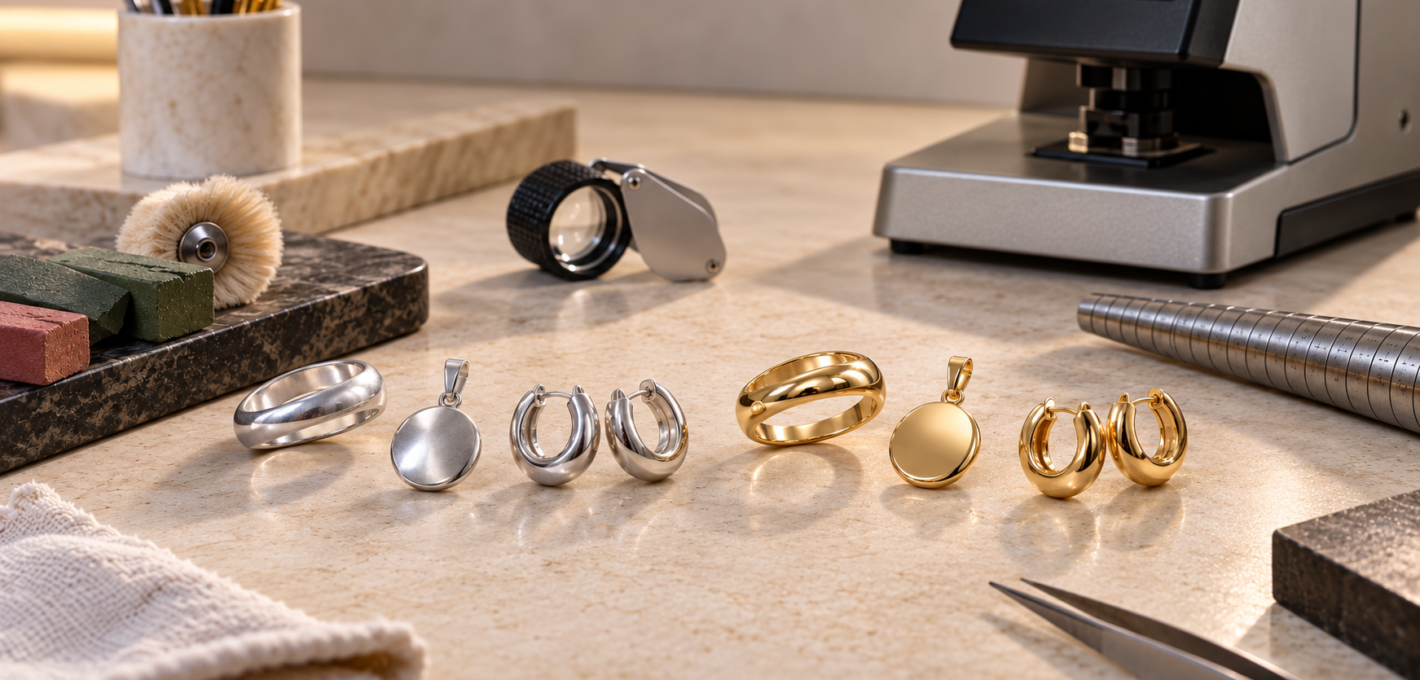
Gold vermeil jewelry looks like gold. It feels like gold. It has the warmth, the color, and the weight of a gold piece.
But beneath that gold surface lies something more — a genuine 925 sterling silver foundation, a real gold plating layer of measurable thickness, and a manufacturing process that determines whether a piece truly qualifies as vermeil or merely claims to be.
At Eon Gems, we are Jaipur-based gold vermeil jewelry manufacturers with 36+ years of experience. This guide takes you through every stage of the vermeil jewelry manufacturing process — from the first design brief to the finished, XRF-verified piece ready for international export.
What Makes Genuine Vermeil Different from Gold-Plated Jewelry
Before exploring the manufacturing process, understanding what separates genuine vermeil from standard gold-plated jewelry is essential. The difference is not cosmetic — it is material and legal.
According to the FTC jewelry guidelines, gold vermeil must meet three specific requirements simultaneously:
Base metal: 925 sterling silver only — not brass, not copper, not any other base metal.
Gold purity: Minimum 10 karats — genuine gold, not gold-colored alloy.
Plating thickness: Minimum 2.5 microns of gold — ten times thicker than standard gold plating.
All three requirements must be met. A piece with silver base but only 0.5 microns of gold is not vermeil. A piece with 2.5 microns of gold over brass is not vermeil. Only the combination of all three produces genuine FTC-compliant vermeil — and only verified manufacturing processes can guarantee all three consistently.
Stage 1 — Design Development and CAD Modelling
Every vermeil jewelry piece begins with a design — not with silver or gold.
Client Brief and Design Consultation
For B2B clients — jewelry brands, wholesale buyers, private-label importers — the process starts with a design brief. Clients submit reference images, sketches, or CAD files alongside written specifications covering dimensions, stone requirements, finish preferences, and quantity range.
Our design team reviews every brief before CAD work begins. Furthermore, they flag any design elements that would create manufacturing challenges — sharp interior corners that trap plating solution, prong geometries that create uneven gold deposition, or stone placements that risk damage during the plating stage.
3D CAD Development
Our German CAM software generates a precise 3D model of the approved design. This model shows exact dimensions and proportions, stone placement and setting type, metal weight estimates for accurate pricing, and setting geometry in full detail.
The CAD model serves two critical functions. First, it gives the client a photorealistic visual for approval before any physical production begins. Second, it gives our production team exact specifications for wax model creation — eliminating interpretation errors between design and physical output.
Digital Approval
Clients review the CAD renders and request any revisions before physical sampling begins. One to two revision rounds are standard. Furthermore, only after written digital approval does physical production commence — protecting both client investment and production time.
Stage 2 — 925 Sterling Silver Casting
With design approved, physical production begins with the silver casting stage — the foundation of every genuine vermeil piece.
Silver Alloy Preparation
Every piece of vermeil at Eon Gems starts with verified 925 sterling silver alloy — 92.5% pure silver and 7.5% copper. The alloy composition is verified before casting begins. Using lower-grade silver alloys is one of the most common quality shortcuts in the industry — and one that directly affects both the hallmarking validity and the gold plating adhesion of the finished piece.
Wax Model Creation
The approved CAD design produces a physical wax model — either through CNC milling of wax blocks for precise reproducible designs, or through 3D resin printing for complex geometries.
The wax model is an exact physical replica of the finished silver piece. At this stage, production teams can verify that the physical proportions match the approved CAD design before committing to metal casting.
Lost-Wax Casting
Wax models attach to a central wax sprue in a branching tree arrangement. The tree goes into a metal cylinder, and liquid investment plaster fills the cylinder completely — capturing every surface detail of every wax model.
After the plaster sets, the cylinder enters a kiln. Heat burns out the wax entirely, leaving a precise negative cavity in the hardened plaster. Molten 925 sterling silver then fills this cavity under centrifugal force or vacuum pressure — replicating every design detail in metal.
After cooling, the plaster breaks away to reveal the silver casting tree. Individual pieces are cut from the tree and move to finishing.
Post-Casting Finishing
Each cast piece requires filing, initial polishing, and quality inspection before stone setting or plating. The cast surface — called casting skin — is removed through progressive polishing stages. Furthermore, each piece is inspected for casting defects including porosity, warping, or incomplete filling before proceeding.
Our 925 sterling silver jewelry manufacturing process at this stage is identical whether the piece will be supplied as silver or used as the base for gold vermeil — the silver quality is the same regardless of final finish.
Stage 3 — Gemstone Setting (Where Applicable)
For vermeil pieces that include gemstones — one of the most popular categories in our manufacturing range — stone setting happens before gold plating. This sequence is critical.
Why Stones Are Set Before Plating
Setting stones after gold plating risks damaging the gold surface with setting tools. Prong pushing, bezel pressing, and pavé bead raising all apply metal force that can scratch, compress, or remove the gold layer in the immediate setting area.
Furthermore, setting before plating ensures that the gold layer covers all metal surfaces — including the inner surfaces of prong tips and bezel rims that contact the stone — creating a consistent gold appearance across the entire visible piece.
Setting Types for Vermeil Jewelry
Our in-house setting bench handles all major setting styles for gemstone vermeil jewelry:
Prong setting — metal prongs hold the stone by its girdle, maximizing light exposure. Each prong must be bent to consistent height and position before plating.
Bezel setting — a continuous metal rim pressed inward to secure the stone. Popular in contemporary vermeil designs for its protective profile and clean aesthetic.
Pavé setting — small stones set in closely spaced holes with metal beads holding each stone. Time-intensive but creates the high-sparkle surface coverage popular in premium vermeil jewelry.
Freeform setting — custom bezels fabricated for irregular cabochon stones — turquoise, labradorite, Ethiopian opal. Each freeform setting is unique to its individual stone.
Stone Security Testing
After setting, every stone is tested for security — gently pressed in multiple directions to confirm no movement. Any stone that shows movement is re-set before the piece proceeds to polishing and plating.
Stage 4 — Pre-Plating Polishing and Surface Finishing
Before gold plating, every piece receives its final surface finish. The finish applied at this stage determines the visual character of the gold surface in the finished piece — because gold plating follows the contours of the silver surface beneath it precisely.
High Polish
A mirror-bright finish produced through progressive polishing compounds. High polish creates the most reflective, classic gold appearance in the finished vermeil piece. Furthermore, it is the most commonly specified finish for contemporary vermeil jewelry.
Matte or Brushed Finish
A controlled surface texture applied after high polishing — creating a satin-like surface that produces a softer, more contemporary gold appearance. Popular in minimalist and Scandinavian-inspired vermeil designs.
Selective Oxidization
In some designs, intentional darkening of recessed areas creates contrast in the silver layer before gold plating is applied selectively. This technique produces multi-tonal vermeil effects — bright gold on raised surfaces, darker tones in recessed areas.
Stage 5 — Pre-Plating Cleaning and Degreasing
This is the most underappreciated stage of the vermeil manufacturing process — and one of the most critical.
Why Pre-Plating Cleaning Matters
Gold plating requires a microscopically clean metal surface. Any contamination — skin oil from handling, polishing compound residue, oxides formed during polishing — creates barriers between the silver surface and the gold ions being deposited. Consequently, contaminated surfaces produce uneven plating, poor adhesion, and premature gold layer failure.
The Cleaning Process
Pieces go through multiple cleaning stages before entering the plating solution. Ultrasonic cleaning removes surface particles and polishing residue through high-frequency vibration in a cleaning solution. Steam cleaning removes residual contamination from recessed areas that ultrasonic cleaning cannot reach. Electrocleaning removes surface oxides through an electrochemical process that leaves the silver surface in ideal condition for gold deposition.
Additionally, pieces are handled only with gloves after cleaning — preventing skin oil contamination before plating begins.
Stage 6 — Gold Electroplating — The Core Process
Gold electroplating is the stage that converts a silver piece into gold vermeil. Furthermore, it is the stage where the most critical quality decisions are made.
The Plating Solution
Our plating solution is a precisely formulated electrolyte containing dissolved gold of the specified karat and color. We offer:
- 10 karat gold — 41.7% gold content, most durable plating layer
- 14 karat gold — 58.3% gold content, warm color, excellent durability
- 18 karat gold — 75% gold content, richest color, most prestigious
Color options include yellow gold (classic warm tone), rose gold (warm pink tone achieved through copper alloy in the gold solution), and white gold (cool bright white tone achieved through rhodium or palladium in the gold solution).
The Electroplating Process
Pieces are suspended in the gold plating solution on specially designed racks that ensure full immersion and even current distribution. An electrical current passes through the solution — causing gold ions to deposit evenly onto every surface of every piece.
Our German precision plating system maintains consistent voltage, current density, and solution temperature throughout each plating cycle. This consistency is what produces uniform gold thickness across an entire batch — not just on the pieces positioned most favorably in the rack.
Plating Thickness Control
Gold plating thickness is controlled by three variables — solution gold concentration, electrical current density, and immersion duration. Our production team adjusts these variables to achieve specified thickness targets:
0.5 microns — fashion grade, not true vermeil by FTC standards
2.5 microns — standard vermeil, FTC-compliant minimum
3.0 microns — premium vermeil, extended wear life
5.0 microns — heavy plate vermeil, maximum durability
For each batch, our team calculates the precise plating parameters required to achieve the specified thickness based on the total surface area of pieces in the batch. Furthermore, this calculation accounts for piece geometry — complex pieces with deep recesses require adjusted parameters to ensure adequate coverage in all areas.
Stage 7 — XRF Thickness Verification
This is the stage that separates trustworthy vermeil manufacturers from those making unverifiable claims.
What XRF Testing Is
XRF (X-ray fluorescence) is a non-destructive analytical technique that measures the thickness of metal layers by analyzing the X-rays emitted when a sample is exposed to an X-ray beam. It is the only accurate method of measuring gold plating thickness on finished jewelry — visual inspection cannot determine whether a piece has 0.5 microns or 2.5 microns of gold.
How We Apply XRF Testing
After every plating batch, our German XRF machine tests representative pieces at multiple measurement points. The machine measures gold layer thickness at the crown of the piece, on side surfaces, and in accessible recessed areas — providing a complete picture of coverage uniformity.
If any measurement falls below the specified thickness, the entire batch returns to the plating stage for additional deposition. Only batches where all measurements confirm the specified thickness proceed to quality control. Furthermore, clients can request the XRF test report as part of their standard shipment documentation — providing documented proof of vermeil compliance for FTC and other regulatory purposes.
Stage 8 — Quality Control Inspection
Before any piece is approved for packaging, it passes through a dedicated quality control inspection conducted independently from the production team.
QC Inspection Points
Every stone is tested for movement — no exceptions. Metal finish is evaluated for uniformity and absence of plating shadows or uneven coverage. Plating color consistency is checked across the entire batch — variations in gold color indicate inconsistent plating parameters. Setting geometry is confirmed — prong heights, bezel evenness, pavé bead consistency. Dimensions are verified against original CAD specifications.
Rejection Standards
Pieces that fail any inspection criterion are either reworked — replated, re-set, or repolished — or removed from the production run. Our target defect rate is under 2% per completed batch. Furthermore, any batch with higher defect rates triggers a production process review before further manufacturing continues.
Stage 9 — 925 Hallmarking and Documentation
Before packaging, every vermeil piece receives its legal and documentary credentials.
925 Hallmarking
Every piece carries a 925 hallmark stamp confirming the sterling silver base metal content. This hallmark is applied to the silver before plating — it remains visible through the gold layer and confirms the genuine silver foundation of every vermeil piece.
Export Documentation
For international shipments, Eon Gems prepares a complete documentation package:
- Commercial invoice with accurate HS codes
- Packing list with physical shipment details
- Certificate of origin confirming Indian manufacture
- 925 hallmark certificate
- XRF plating thickness report
- Airway bill from DHL or FedEx
This documentation package supports FTC compliance for USA buyers, hallmarking requirements for UK buyers, and customs documentation requirements for all major export markets.
Stage 10 — Packaging and Export
The final stage — preparing finished vermeil pieces for international shipping.
Each piece is individually wrapped in anti-tarnish tissue. For clients with custom packaging — branded boxes, custom pouches, hang tags — our team assembles complete branded packages at this stage.
Export cartons are packed with cushioning to prevent movement during transit. Our DHL and FedEx partnerships ensure daily pickup from our facility — with 3 to 5 day delivery to USA, UK, and European destinations.
How Long Does the Vermeil Manufacturing Process Take?
- Design brief to CAD approval — 3 to 7 days
- Physical sample production — 10 to 20 days after CAD approval
- Sample shipping — 3 to 5 days
- Bulk production (including all stages above) — 3 to 6 weeks
- QC, hallmarking, and packaging — 3 to 5 days
- Export shipping via air freight — 3 to 5 days
Total from first brief to delivered bulk order — approximately 10 to 14 weeks.
Why the Manufacturing Process Determines Vermeil Quality
The vermeil manufacturing process is not just a sequence of steps — it is the system that determines whether a piece genuinely delivers on the vermeil promise.
Shortcuts at any stage compromise the finished product. Substandard silver alloy compromises hallmarking validity and plating adhesion. Inadequate pre-plating cleaning produces uneven coverage and premature wear. Skipping XRF verification means plating thickness is unverified — and claimed thickness numbers are meaningless without measurement.
Furthermore, the gap between a brand’s vermeil claims and the actual product quality is what drives customer returns, negative reviews, and long-term brand damage. In contrast, a verified manufacturing process — documented at every stage — is what allows brands to make their vermeil claims confidently and accurately.
FAQs — Vermeil Jewelry Manufacturing Process
What is the difference between vermeil and gold-plated jewelry in manufacturing?
The base metal and plating thickness are the key differences. Genuine vermeil uses 925 sterling silver as the base — hallmarked and documented. The gold plating is minimum 2.5 microns — verified by XRF machine. Standard gold plating uses brass or copper as the base with 0.03 to 0.5 microns of gold — without systematic thickness verification.
Why must stones be set before gold plating?
Setting stones after plating risks damaging the gold surface with setting tools. Furthermore, pre-plating stone setting ensures the gold layer covers all metal surfaces including prong tips and bezel rims — creating a consistent gold appearance across the entire visible piece.
How is gold plating thickness verified?
XRF (X-ray fluorescence) is the only accurate method of measuring gold plating thickness on finished jewelry. Visual inspection cannot determine thickness. Consequently, any manufacturer who cannot provide XRF test reports is offering unverified thickness claims.
Can gold vermeil be re-plated?
Yes — this is one of vermeil’s significant advantages. When the gold layer shows wear, a jeweler can re-plate the piece, restoring the gold finish completely. Because the base is 925 silver rather than brass, the piece can be re-plated multiple times without degradation of the base material.
What gold karat is best for vermeil jewelry?
18 karat gold (75% gold) produces the richest color and most prestigious finish. Furthermore, 18k yellow gold vermeil has the strongest market positioning for premium jewelry brands. 14 karat is an excellent balance of color richness and durability. 10 karat is the FTC minimum and is most cost-effective for fashion-forward collections.
Eon Gems — Verified Vermeil Jewelry Manufacturer in Jaipur
At Eon Gems, every stage of the vermeil manufacturing process described in this guide happens in-house — design, casting, stone setting, polishing, pre-plating cleaning, electroplating, XRF verification, QC, hallmarking, and export documentation. Nothing is outsourced.
With 36+ years of gold vermeil jewelry manufacturing experience, we supply jewelry brands and wholesale buyers across 50+ countries with fully documented, FTC-compliant vermeil jewelry.
What we offer:
- Full in-house vermeil manufacturing — every stage on-site
- German XRF verification on every batch — reports available on request
- 925 hallmarking as standard on every piece
- Gold options — 10k, 14k, 18k — yellow, rose, and white gold
- Plating thickness — 2.5 microns to 5 microns
- 925 sterling silver and gemstone manufacturing alongside vermeil
- No MOQ — single prototype to large bulk production
- Complete export documentation for all major markets
👉 Get a Free Quote from Eon Gems →
🔗 Gold Vermeil Jewelry Manufacturing →
🔗 925 Sterling Silver Jewelry →
🔗 Gemstone Jewelry Manufacturing →