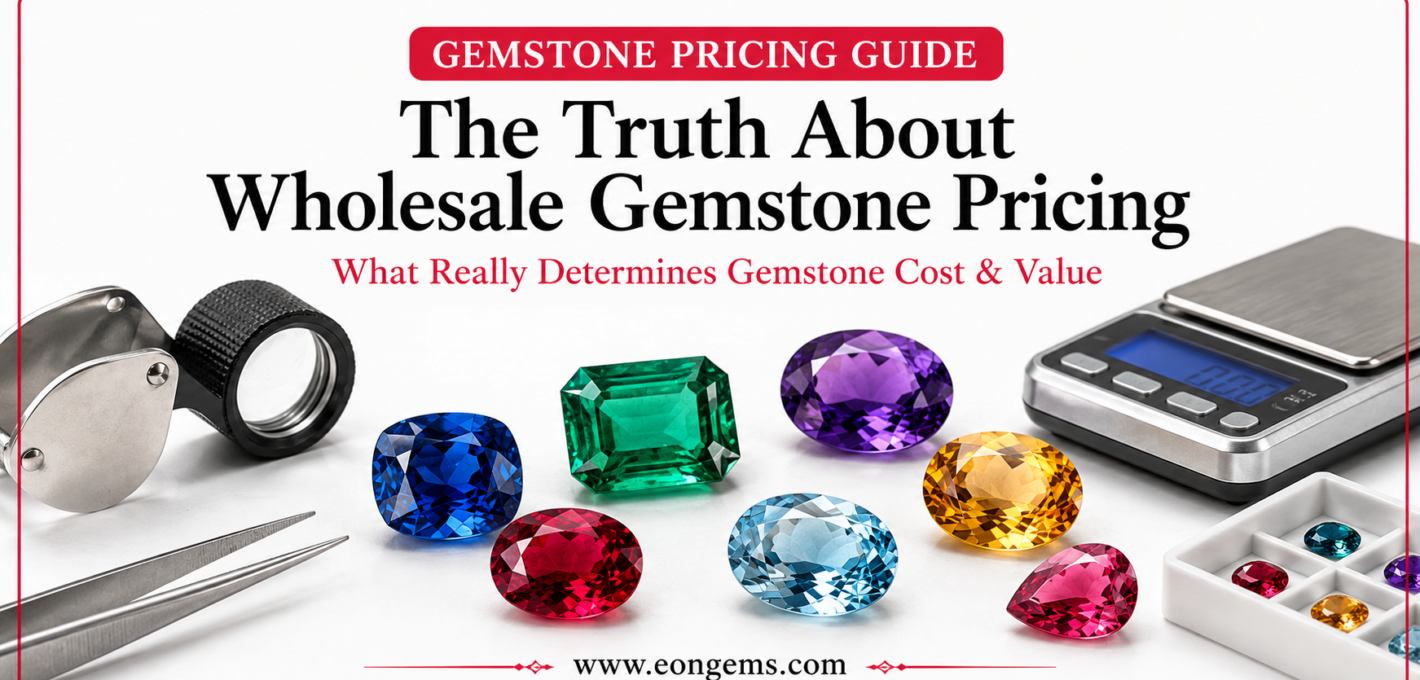
The Truth About Wholesale Gemstone Pricing
Most wholesale gemstone pricing conversations start with a number. They should start with a question.
The question is not “how much does this stone cost?” The question is “why does this stone cost what it costs?” Understanding the answer to the second question separates buyers who get consistent value from buyers who consistently overpay — or worse, underpay for stones that are not what they appear to be.
At Eon Gems, we are Jaipur-based gemstone jewelry manufacturers with 36+ years of direct gemstone market experience. Furthermore, we source stones daily from Jaipur’s gem markets — the world’s largest colored gemstone trading hub. This guide shares everything we know about how wholesale gemstone pricing actually works.
Why Gemstone Pricing Is Unlike Any Other Commodity
Gemstones are not priced like gold or silver. Gold has a live spot price that anyone can check in real time. Silver has the same. In contrast, colored gemstone pricing has no universal reference point — no exchange-traded price, no Bloomberg ticker.
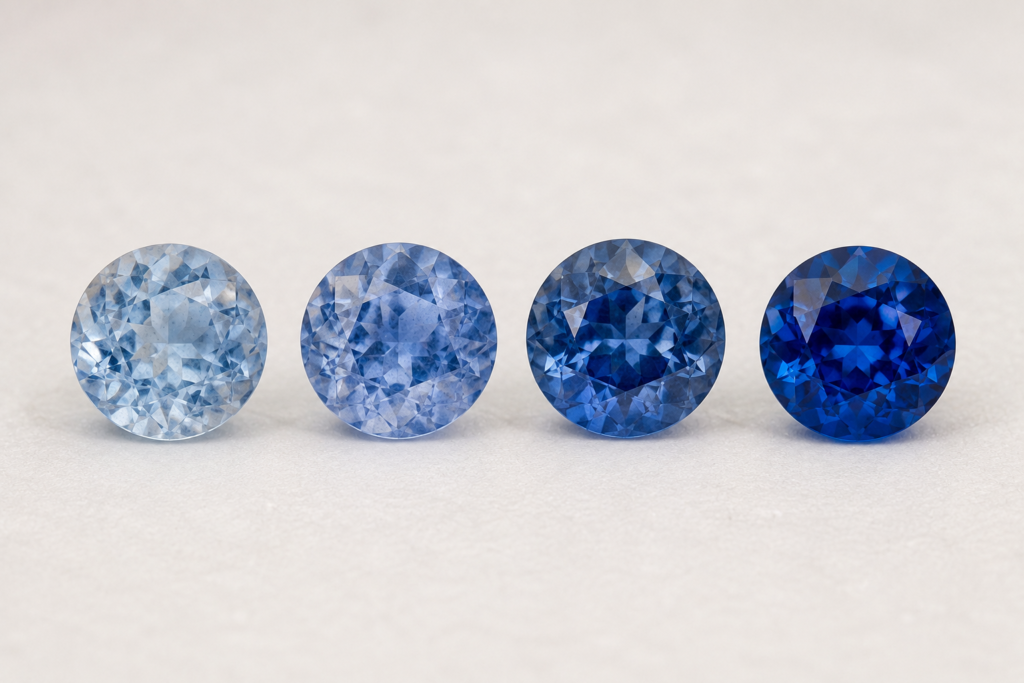
Every colored gemstone is unique. Two blue sapphires of identical carat weight can differ in price by a factor of 100 — or more — depending on color, clarity, origin, cut, and treatment status. Consequently, wholesale gemstone pricing requires knowledge, judgment, and market experience that no chart or calculator can replace.
This is the first truth about wholesale gemstone pricing. There is no single correct price for any colored gemstone. There is only the price that reflects that specific stone’s quality — and the market knowledge to determine whether the quoted price reflects that quality accurately.
The Seven Factors That Determine Wholesale Gemstone Price
1. Color — The Most Influential Factor
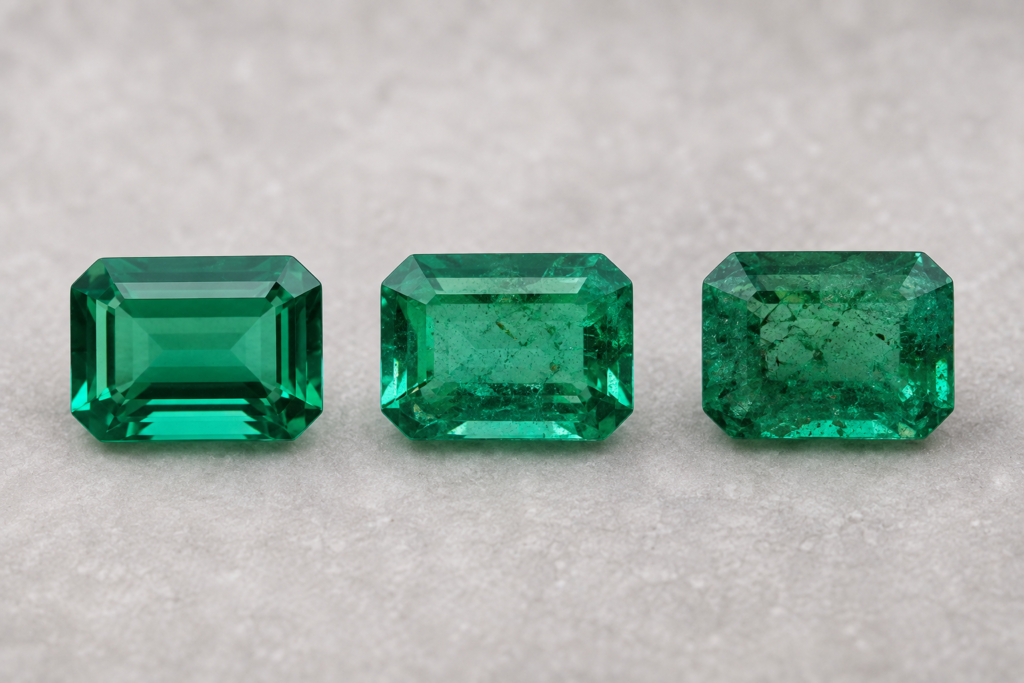
Color is the single most important pricing factor for colored gemstones — more important than clarity, more important than size in most cases.
Three dimensions of color determine value. Hue is the basic color of the stone — blue, red, green, purple, orange. Tone is how light or dark the color appears. Saturation is the intensity or purity of the color — from pale and washed-out to vivid and rich.
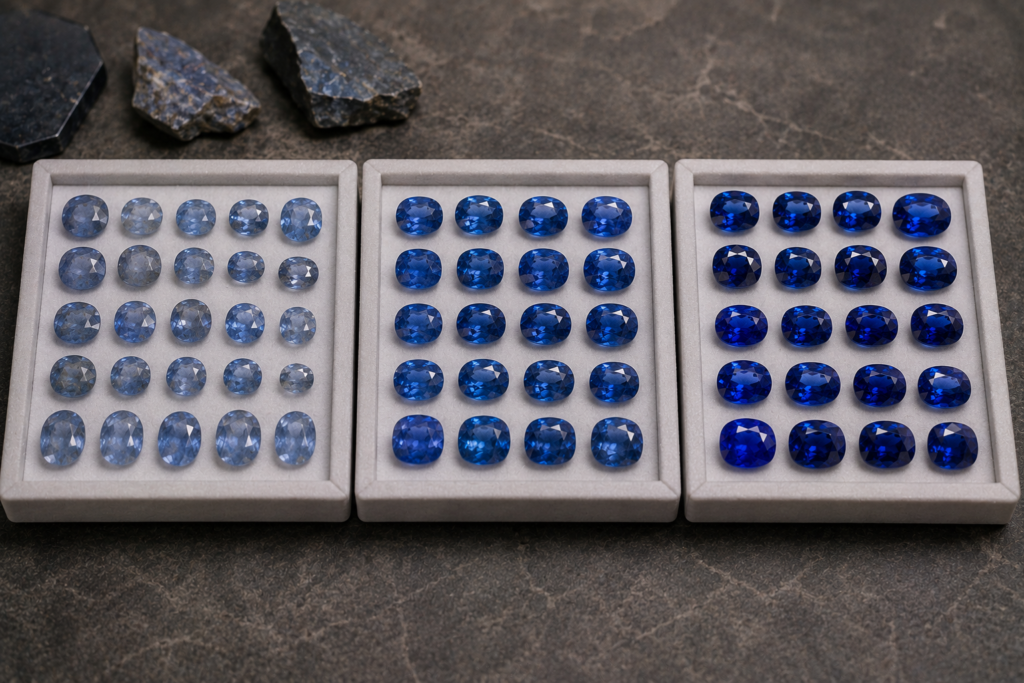
Fine color commands extraordinary premiums. A blue sapphire with vivid, highly saturated cornflower blue can cost 10 to 50 times more per carat than a sapphire of the same weight with pale, desaturated color. Furthermore, even small differences in color quality within the fine grade create significant price differences.
Practical implication for buyers: When comparing wholesale quotes for the same stone species, color specification is the most critical variable. “Blue sapphire, 5mm round” describes a price range of $2 to $500+ per carat. Additionally, always request photographs under multiple light sources — stones look very different under daylight versus incandescent light.
2. Clarity — The Second Factor
Clarity covers the presence, size, position, and visibility of inclusions — internal characteristics formed during the stone’s growth. However, clarity standards differ significantly between stone species.
Diamonds follow a strict inclusion scale where even minor inclusions invisible to the naked eye affect price. Colored gemstones, in contrast, follow a more pragmatic standard. Most colored gemstones contain some inclusions. Therefore, what matters is whether inclusions affect the stone’s appearance, structural integrity, or visibility during normal wear.
According to the GIA Gem Encyclopedia, gemologists categorize colored gemstones into three clarity types. Type I stones — aquamarine, topaz, citrine — typically grow with few inclusions. Type II stones — sapphire, ruby, garnet — typically contain inclusions, and eye-clean specimens command premiums. Type III stones — emerald, red tourmaline — almost always contain inclusions, and eye-clean specimens are exceptionally rare.
3. Treatment Status — The Hidden Pricing Variable
This is the factor that surprises most first-time wholesale gemstone buyers — and the one that creates the most pricing confusion in the market.
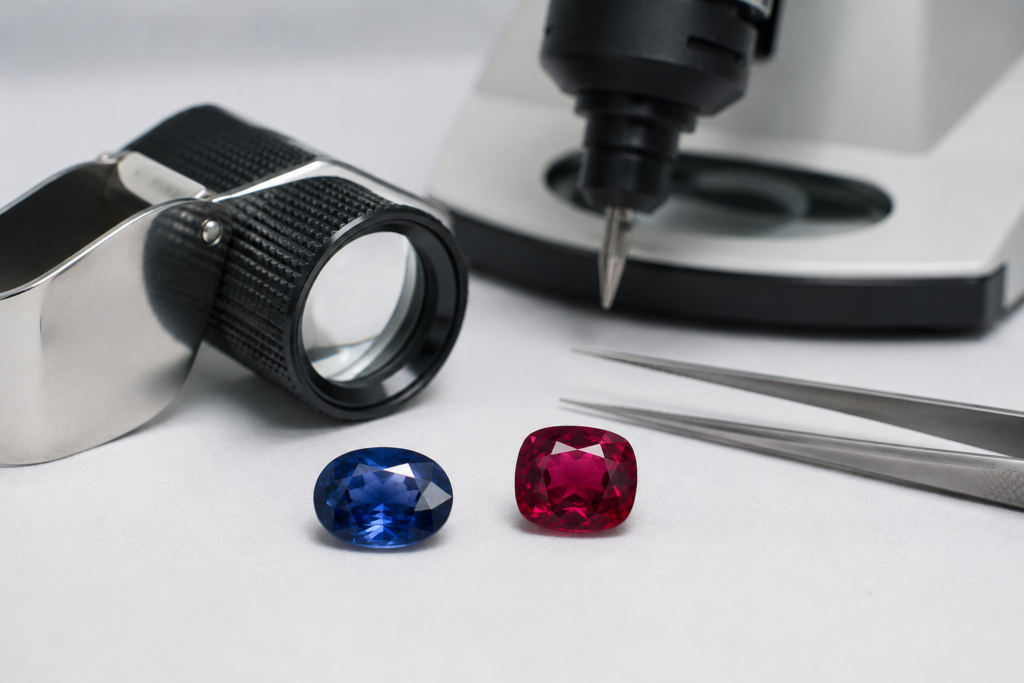
Most colored gemstones in the wholesale market have undergone treatment to enhance their appearance. Heat treatment is the most common — applied to the majority of rubies and sapphires to improve color and clarity. The trade widely accepts heat treatment as standard practice. However, sellers must disclose it on every invoice.
The pricing impact of treatment: Untreated natural stones of fine quality command dramatic premiums over heat-treated stones of equivalent appearance. For blue sapphire, an unheated stone of fine quality can cost 2 to 5 times more than an equivalent heat-treated stone. For ruby, the premium for unheated stones is even more extreme.
More invasive treatments — beryllium diffusion, fracture filling with glass or resin — carry significantly lower prices and require full disclosure. Furthermore, these treatments affect the stone’s durability and long-term appearance in ways that heat treatment does not.
What to ask every supplier: “Is this stone treated? What specific treatment was applied? Is this disclosed on your invoice?” A supplier who hesitates gives vague answers. Furthermore, any inability to provide documentation is a serious red flag. Additionally, discouraging certification often means protecting a quality claim that professional testing would not support.
4. Origin — The Provenance Premium
Geographic origin affects wholesale gemstone pricing significantly — particularly for fine quality stones.
Some origins carry consistent quality associations. Kashmir sapphire — mined from a region of northern India where mining essentially ceased in the early 20th century — is the most prestigious origin for blue sapphire. Colombian emerald carries a similar prestige premium. Burmese (Myanmar) ruby is the gold standard for fine ruby.
Why origin matters: Stones from prestigious origins carry not just quality associations but historical and rarity value. Furthermore, origin certificates from respected gemological laboratories like GIA verify origin claims — unverified origin claims are not worth a price premium.
The practical reality: For most jewelry brands, origin matters most at the fine and collector grade level. At commercial and good grade, stones from less prestigious origins often deliver excellent quality at more accessible pricing. Consequently, most wholesale buyers purchasing for jewelry manufacturing do not need to prioritize origin premiums.
5. Cut Quality — The Often Overlooked Factor
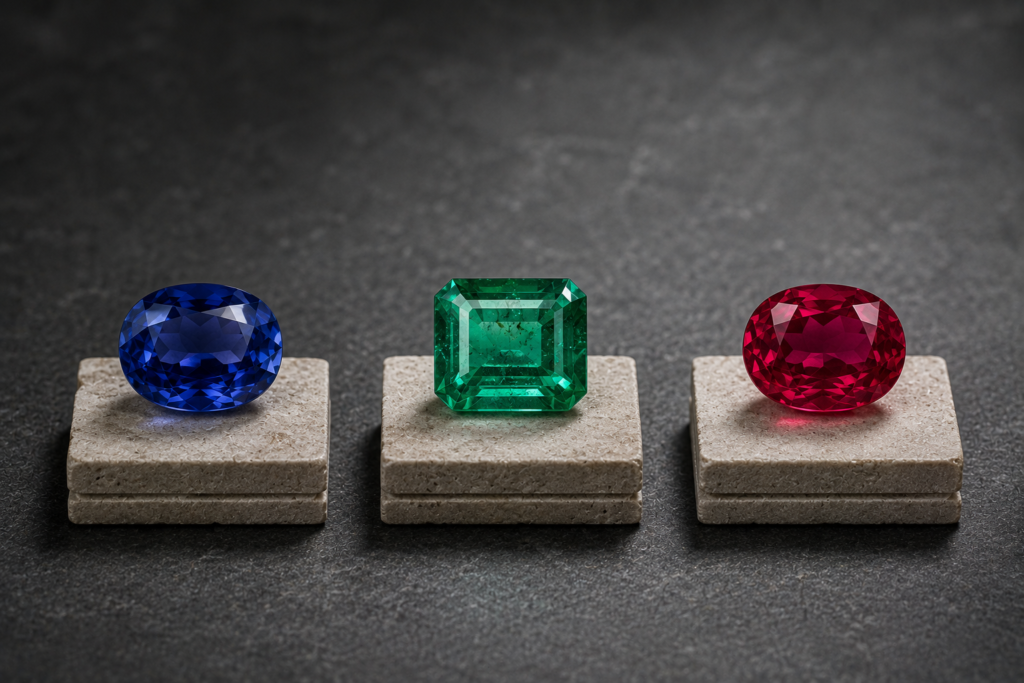
Cut quality affects how well a gemstone displays its color and brilliance — and consequently how visually impactful it appears in finished jewelry.
A well-cut stone maximizes color display. It shows vivid, even color across the face with minimal windowing or extinction. Furthermore, a well-cut stone fits standard jewelry settings precisely — critical for manufacturing efficiency.
A poorly cut stone — cut to maximize weight retention from the rough rather than optical performance — can appear significantly less attractive despite good material quality. Additionally, off-size or irregular cuts create setting challenges that add labor cost to finished jewelry.
6. Carat Weight — Size and Its Non-Linear Effect
Gemstone pricing does not scale linearly with weight. A 2-carat blue sapphire of fine quality costs significantly more than twice the price of a 1-carat sapphire of equivalent quality — because larger stones are rarer.
Price-per-carat increases at specific weight thresholds — commonly called “magic sizes” in the trade. Stones just below 1 carat, 2 carats, and 3 carats are often priced significantly lower per carat than stones just above those thresholds.
Practical implication: For wholesale buyers with flexibility on exact stone size, specifying “approximately 0.9 to 1.0 carat” rather than “exactly 1 carat” can produce meaningful per-carat savings without significant visual difference in the finished piece.
7. Supply and Demand — The Market Factor
Gemstone prices respond to supply and demand dynamics that shift over time — sometimes dramatically.
Ethiopian opal disrupted opal pricing significantly — offering vivid play-of-color material at dramatically lower prices than Australian opal. Tanzanite prices have fluctuated with mining developments. Lab-grown diamond prices have fallen 60 to 80 percent over five years as production scaled.
Furthermore, fashion cycles affect demand. Social media trends push certain stone varieties — labradorite, moonstone, and Ethiopian opal have all benefited from boho and spiritual jewelry trends. Consequently, wholesale buyers who source ahead of trend cycles get better pricing than those who buy at peak demand.
The Truth About “Wholesale” Pricing Claims
Many sellers claim to offer wholesale pricing. Not all of them deliver on that claim. Understanding the three pricing categories protects buyers from costly mistakes.
True Wholesale Pricing
True wholesale pricing reflects the cost of producing or sourcing the stone plus a reasonable margin for a volume or trade buyer. It is significantly lower than retail pricing and requires either an established trade relationship or volume purchasing to access consistently.
Inflated “Wholesale” Pricing
Inflated “wholesale” pricing is retail pricing with a wholesale label — common in tourist-oriented gem markets, online marketplaces, and sellers targeting first-time buyers without market price knowledge. Consequently, buyers without reference pricing are most vulnerable to this category.
Below-Market Pricing — The Danger Zone
Below-market pricing is the most dangerous category — stones priced significantly below market levels for their stated quality almost always involve quality misrepresentation. The stone is not what it is claimed to be: wrong species, undisclosed treatment, synthetic material presented as natural, or significantly lower quality grade than stated.
The second truth of wholesale gemstone pricing is this: if a price seems too good to be true, it almost always reflects a problem with the stone. Consequently, buyers who chase the lowest price consistently pay for it in quality failures, customer returns, and brand reputation damage.
How Wholesale Pricing Differs by Stone Category
Precious Stones — Ruby, Sapphire, Emerald, Diamond
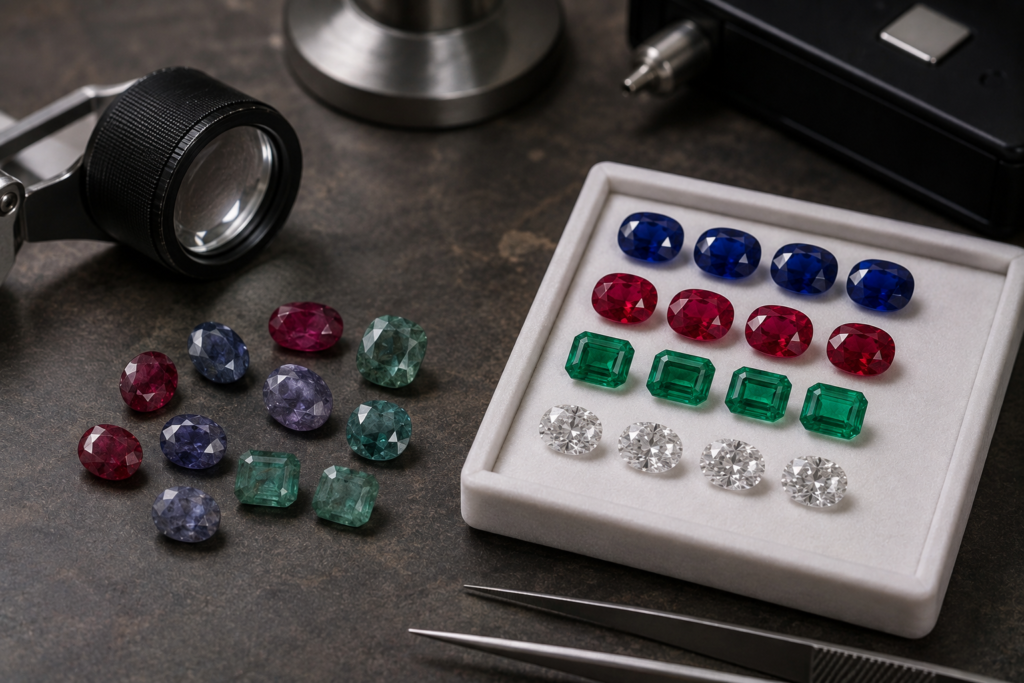
Precious stones have the widest quality-driven price ranges of any gemstone category. Furthermore, treatment status has the most dramatic pricing impact here.
Starting at the accessible end — commercial grade (heat-treated, included, standard color): $5 to $50 per carat. Moving up in quality — good grade (eye-clean, good color, heat-treated): $50 to $500 per carat. At the premium level — fine grade (eye-clean, vivid color, minimal treatment): $500 to $5,000+ per carat. At the top end — unheated fine grade commands $2,000 to $50,000+ per carat depending on species and size.
Lab-grown ruby and sapphire: $2 to $20 per carat — chemically identical to natural, excellent visual quality. Lab-grown emerald: $3 to $25 per carat.
Semi-Precious Colored Stones
Semi-precious stones — amethyst, citrine, garnet, tourmaline, aquamarine, morganite — offer better value accessibility than precious stones while delivering excellent visual impact in finished jewelry.
Amethyst (commercial to good grade, calibrated): $0.50 to $5 per carat. Blue topaz (good grade, calibrated): $0.50 to $3 per carat. Standard garnet varieties: $1 to $10 per carat. Premium garnet varieties (tsavorite, demantoid): $50 to $500+ per carat. Standard tourmaline colors: $3 to $30 per carat. Paraiba tourmaline: $500 to $10,000+ per carat.
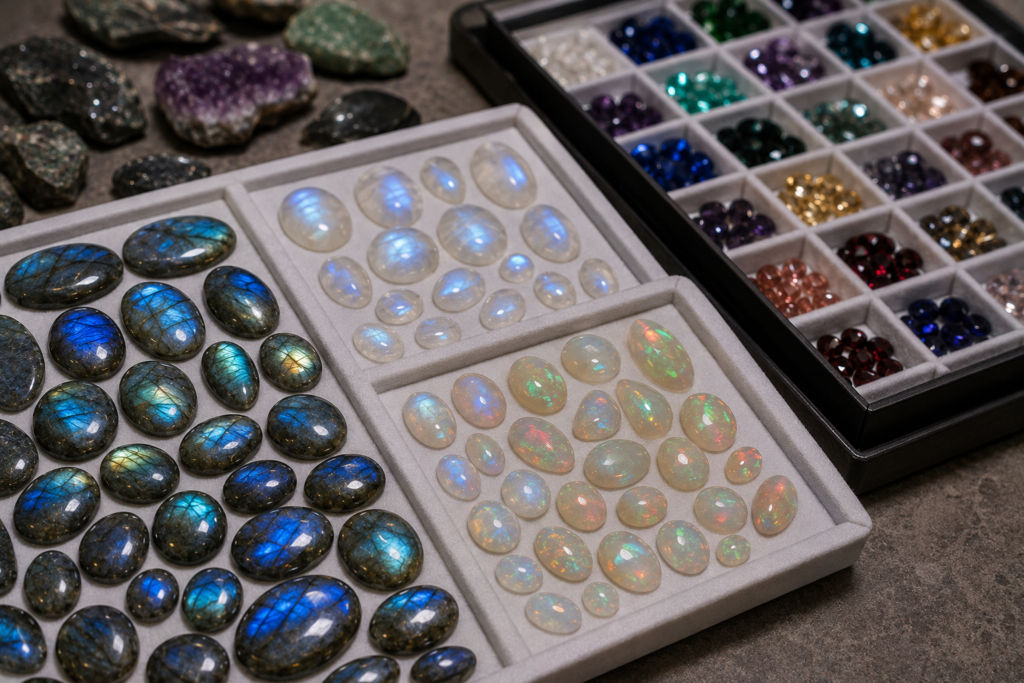
Phenomenal Stones — Moonstone, Labradorite, Opal
These stones are priced primarily on the quality and character of their optical phenomenon rather than conventional clarity and color grading.
Moonstone (commercial to good grade, calibrated cabochon): $0.50 to $8 per stone. Fine blue sheen moonstone: $5 to $50+ per stone. Labradorite (good spectral flash): $0.50 to $5 per stone. Ethiopian opal (good play-of-color): $3 to $30 per carat. Australian opal (fine quality): $20 to $200+ per carat.
Lab-Grown Stones
Lab-grown stones offer dramatic cost savings versus natural equivalents while delivering identical chemical and optical properties.
Lab-grown blue sapphire: $2 to $15 per carat. Lab-grown ruby: $2 to $10 per carat. Lab-grown emerald: $3 to $25 per carat. Moissanite: $50 to $200 per carat. Lab-grown alexandrite: $5 to $30 per carat.
Red Flags in Wholesale Gemstone Pricing
Knowing what to watch for protects wholesale buyers from the most costly gemstone sourcing mistakes.
Prices Below Market for Stated Quality
Genuine wholesale pricing is lower than retail but not dramatically below what established traders charge. Prices that seem too good almost always reflect quality misrepresentation — not a genuine bargain.
Missing Treatment Disclosure
Every legitimate wholesale supplier discloses treatment status on commercial invoices. Absence of treatment disclosure is not just a legal risk. Furthermore, it is a strong indicator that the supplier has something to hide about the stone’s quality or origin.
Resistance to Gemological Certification
For purchases above $200 to $300 per stone, gemological certificates from GIA, IGI, or AGL are standard in the legitimate wholesale trade. A supplier who discourages certification is often protecting a quality claim that professional testing would not support. Additionally, this resistance is a clear sign to proceed with caution.
Vague Quality Descriptions
“Good quality blue sapphire” means nothing without color specification, clarity grade, and treatment status. “Natural” without “untreated” means the stone has likely been heat-treated — which is acceptable if disclosed but problematic if the pricing implies untreated quality.
High-Pressure Tactics
Legitimate wholesale suppliers let buyers evaluate stones carefully. High-pressure tactics — “this price is only good today,” “I have another buyer ready” — are manipulation tools common in tourist-oriented gem markets. Consequently, any pressure to decide quickly should prompt buyers to slow down, not speed up.
How to Get the Best Wholesale Gemstone Pricing
Build Long-Term Supplier Relationships
The best wholesale pricing flows from established, trusted relationships. Buyers with track records of reliable payment, consistent ordering, and fair dealing get preferential access to quality material and better pricing than first-time buyers.
At Eon Gems, our longest-standing client relationships span 10 to 20 years. Furthermore, these clients get first access to exceptional incoming material and pricing that reflects the trust built over years of consistent partnership.
Specify Clearly and Buy in Volume
Clear specifications reduce sorting time and pricing uncertainty for suppliers — which translates into better pricing for buyers. Furthermore, buying volume of a specific stone variety in a single order produces better per-carat pricing than buying small mixed quantities across many varieties.
Source from Jaipur Directly
Jaipur’s position as the world’s largest colored gemstone trading hub means stones are available at source-market pricing — without the secondary markups added when stones travel through Dubai, Bangkok, or Western trading centers.
At Eon Gems, our gemstone jewelry manufacturing operation sources directly from Jaipur’s market daily. Furthermore, our 925 sterling silver and gold vermeil jewelry manufacturing means stones move directly from sourcing to setting without additional logistics cost.
Match Quality Grade to Retail Positioning
Sourcing commercial grade stones for premium jewelry positioned at high retail prices creates a product that cannot sustain its pricing when customers examine it closely. In contrast, sourcing fine grade stones for mid-market jewelry erodes margins without delivering proportional retail price uplift.
Consequently, quality grade alignment with retail positioning is one of the most commercially important gemstone sourcing decisions a brand makes.
FAQs — Wholesale Gemstone Pricing
Why do two stones of the same species cost completely different prices?
Color, clarity, treatment status, origin, cut quality, and size all interact to create dramatically different value levels within the same species. A commercial grade heat-treated blue sapphire and a fine grade unheated Ceylon sapphire are both “blue sapphire” — but their wholesale prices can differ by a factor of 100 or more.
Is it safe to buy gemstones online at wholesale prices?
It depends entirely on the supplier’s credibility and documentation practices. Reputable online wholesale suppliers provide detailed quality specifications, treatment disclosure on invoices, and gemological certificates for significant stones. Furthermore, they accept returns for misrepresented material. Suppliers who cannot provide these are high-risk regardless of their pricing.
Why do Jaipur-based suppliers offer better pricing than other sources?
Jaipur is where the global colored gemstone supply chain concentrates — rough stones arrive from mines worldwide, get cut and traded here, and distribute globally from this market. Buying from Jaipur-based suppliers eliminates the secondary markups added at each step of the supply chain. Consequently, buyers access source-market pricing rather than secondary-market pricing.
How do I know if a wholesale price is fair?
Research market pricing for the specific quality grade and treatment status of the stone you are buying — not just the species. Furthermore, get quotes from multiple established suppliers and compare quality specifications alongside price. A significantly lower quote almost always reflects lower quality, not better value.
Should I buy natural or lab-grown stones for wholesale jewelry manufacturing?
This depends on your brand positioning and price point. Lab-grown stones offer excellent visual quality at dramatically lower prices — ideal for accessible price points or consistent quality across large production runs. Natural stones, in contrast, suit premium positioning, artisan collections, and markets where natural origin matters to buyers.
Eon Gems — Transparent Wholesale Gemstone Pricing in Jaipur
At Eon Gems, transparent pricing is a core principle — not a marketing claim. Every quote includes itemized stone cost with quality specification, treatment status, and origin. Furthermore, we never substitute stones after quoting — what we quote is what ships.
With 36+ years of direct Jaipur gemstone market access, we source 250+ natural and lab-grown stone varieties with full treatment disclosure as standard — integrated directly into our gemstone jewelry manufacturing process.
What we offer:
- Transparent, itemized gemstone pricing with quality specification
- Full treatment disclosure on every invoice as standard
- 250+ natural gemstone varieties — direct Jaipur market sourcing
- Lab-grown options — ruby, sapphire, emerald, moissanite, alexandrite
- GIA and IGI certificates available on request
- 925 sterling silver and gold vermeil manufacturing alongside stone sourcing
- No MOQ — single stone to large volume orders
- Complete export documentation for all major markets
👉 Get a Transparent Quote from Eon Gems →
🔗 Gemstone Jewelry Manufacturing →
🔗 925 Sterling Silver Jewelry →
🔗 Gold Vermeil Jewelry →