Turquoise is one of the oldest gemstones in human history — and one of the most powerful in crystal healing tradition.
For over 6,000 years, cultures from ancient Egypt to Native America, from Persia to Tibet, have treasured turquoise for its beauty, its protective energy, and its deep spiritual significance. Today, it remains one of the most popular stones in jewelry worldwide — beloved equally for its distinctive blue-green color and its rich tradition of healing and protection.
At Eon Gems, we are Jaipur-based gemstone jewelry manufacturers with 36+ years of experience sourcing and setting natural turquoise for jewelry brands and wholesale buyers worldwide. This complete guide covers turquoise stone benefits, meaning, healing properties, and everything you need to know about turquoise jewelry.
What Is Turquoise?
Turquoise is a hydrous phosphate of copper and aluminum — a mineral formed through the interaction of water with copper-rich rock over millions of years. Its distinctive blue-green color comes from the copper content — higher copper produces more vivid blue tones, while iron and other minerals shift the color toward green.
Turquoise rates 5 to 6 on the Mohs hardness scale — relatively soft compared to other gemstones. Furthermore, it is an opaque stone, meaning light does not pass through it — making cabochon cuts the standard for turquoise in jewelry rather than faceted cuts.
The finest natural turquoise comes from several key sources. Persian turquoise from Iran — particularly from the Nishapur mines — has been prized for centuries for its vivid sky blue color. American Southwest turquoise from mines in Arizona, Nevada, and New Mexico — including famous varieties like Sleeping Beauty, Kingman, and Bisbee — is deeply significant in Native American jewelry tradition. Furthermore, turquoise from Tibet, China, and Mexico adds to the global supply chain.
Turquoise Stone Benefits — Healing and Spiritual Properties
Turquoise has been valued for its healing and protective properties across cultures for thousands of years. In modern crystal healing traditions, it carries some of the strongest and most consistent associations of any healing stone.
Protection and Grounding
Turquoise is widely considered one of the most powerful protection stones in crystal healing tradition. Ancient warriors wore it in battle for protection. Travelers carried it for safe journey. Furthermore, contemporary crystal healers associate turquoise with shielding the wearer from negative energy, psychic attack, and environmental pollutants.
Its grounding energy helps wearers stay centered and calm during challenging or stressful situations — making it particularly valued by people in high-pressure professional environments or going through periods of significant change.
Communication and Self-Expression
Turquoise is associated with the throat chakra — the energy center governing communication, truth, and self-expression. Crystal healers believe wearing turquoise supports clear, authentic communication. It helps wearers speak their truth, express their thoughts with confidence, and listen more deeply to others.
Furthermore, turquoise is associated with reducing communication anxiety — particularly useful for public speakers, teachers, performers, and anyone who finds verbal self-expression challenging.
Emotional Healing and Balance
One of the most consistently cited turquoise stone benefits is emotional healing. It is believed to stabilize mood swings, calm anxiety, and bring a sense of inner peace during emotionally turbulent periods.
Additionally, turquoise is associated with helping wearers release old patterns, heal from past trauma, and move forward with greater emotional resilience. It is considered a stone of wholeness — integrating all parts of the self into a more balanced whole.
Physical Healing Associations
In traditional healing practices, turquoise carries associations with physical wellbeing. Crystal healing traditions associate it with the immune system, respiratory health, and the body’s anti-inflammatory response. Furthermore, it is traditionally associated with detoxification — helping the body clear environmental and energetic toxins.
It has also been associated with eye health, headache relief, and supporting recovery from exhaustion — though these associations come from traditional healing practice rather than modern medical evidence.
Intuition and Spiritual Connection
Turquoise bridges the physical and spiritual worlds in many healing traditions. It is associated with enhancing intuition, supporting meditation, and deepening the connection between the physical self and higher wisdom.
In Native American tradition, turquoise is considered a sacred stone that connects Earth and Sky — grounding physical energy while opening awareness to spiritual guidance. Furthermore, in Tibetan tradition, turquoise is considered a protective talisman that brings good fortune and spiritual protection.
Turquoise Chakra Associations
In the chakra healing system, turquoise primarily resonates with the throat chakra (Vishuddha) — the energy center located at the throat associated with communication, truth, and creative expression.
Throat Chakra
When the throat chakra is balanced, communication flows naturally — we speak our truth clearly, listen deeply, and express ourselves creatively without fear. Turquoise is one of the primary stones for activating and balancing this chakra.
Furthermore, turquoise also resonates with the third eye chakra (Ajna) in some healing traditions — supporting intuitive perception and the ability to see situations clearly from a higher perspective.
Heart Chakra
Some crystal healing practitioners also associate turquoise with the heart chakra (Anahata) — particularly for its emotional healing and compassion-enhancing properties. The blue-green color bridges the heart chakra’s green frequency and the throat chakra’s blue frequency — making turquoise a natural heart-throat bridge stone.
Turquoise in Different Cultural Traditions
Ancient Egypt
Turquoise was one of the first gemstones mined by ancient Egyptians — with mines in the Sinai Peninsula dating to at least 3200 BCE. It was associated with the goddess Hathor, “Lady of Turquoise,” and was used extensively in royal jewelry, funerary objects, and sacred amulets. Furthermore, Tutankhamun’s famous burial mask incorporated turquoise alongside gold and lapis lazuli.
Native American Tradition
Turquoise holds perhaps its deepest cultural significance in Native American tradition. For the Navajo, Pueblo, Zuni, and many other peoples of the American Southwest, turquoise is a sacred stone associated with sky, water, and life itself. It is used in ceremonial jewelry, woven into traditional patterns, and given as gifts of blessing and protection.
Additionally, Native American turquoise jewelry — particularly the distinctive silver and turquoise work of Navajo and Pueblo artisans — is one of the most recognized and influential jewelry traditions in the world.
Persian Tradition
Persian turquoise from the Nishapur mines has been treasured for over 2,000 years. In Persian tradition, turquoise is considered the national gemstone — symbolizing heaven on earth. It was used extensively in architecture, royal regalia, and personal adornment. Furthermore, the word “turquoise” itself derives from the French “Pierre turquoise” — “Turkish stone” — reflecting the trade route through Turkey by which Persian turquoise reached Europe.
Tibetan Tradition
In Tibet, turquoise is one of the most sacred and significant stones in the entire culture. It is associated with prosperity, good fortune, and protection. Furthermore, Tibetan turquoise jewelry — often combined with coral and silver — is deeply embedded in religious and ceremonial life.
Types of Turquoise — What’s Available in the Market
Understanding turquoise varieties helps buyers make informed purchasing decisions — whether sourcing for personal jewelry or wholesale collections.
Natural Untreated Turquoise
The most valuable category — turquoise in its natural state without any treatment. Natural untreated turquoise of fine quality and vivid color is increasingly rare. It commands significant premiums over treated material. Furthermore, it is the preferred choice for collectors, high-end jewelry, and buyers who value energetic purity for crystal healing use.
Stabilized Turquoise
The most common commercial turquoise. Natural turquoise is porous — in lower grade material, this porosity makes it fragile and prone to absorbing oils, chemicals, and color changes. Stabilization involves impregnating the stone with a clear resin under pressure — hardening it and improving its durability and color stability.
Stabilized turquoise is entirely genuine natural turquoise — only the treatment status differs from natural untreated material. It is widely accepted in the trade and must be disclosed. Furthermore, it offers excellent color, good durability, and accessible pricing for jewelry manufacturing.
Treated or Enhanced Turquoise
Some lower-grade turquoise undergoes more intensive treatment — including dyeing to enhance or change color, or wax treatment for surface improvement. These treatments must be disclosed. Dyed turquoise carries lower value than natural or stabilized material. Additionally, dyed material may fade over time with exposure to light and chemicals.
Simulated or Imitation Turquoise
Several materials are sold as turquoise imitations — howlite dyed blue-green, plastic, glass, and various synthetic materials. These are not genuine turquoise at all. Consequently, knowing how to identify real turquoise is important for both buyers and brands.
At Eon Gems, we source natural turquoise with full treatment disclosure as standard — available in both stabilized and higher-grade natural material for our gemstone jewelry manufacturing operation.
How to Identify Real Turquoise
Check the Price
Genuine natural turquoise at good quality carries real value. If a price seems dramatically low for the stone’s apparent quality and size, it is likely imitation or heavily treated material. Real turquoise cannot be produced cheaply at scale — consequently, very low prices are a reliable red flag.
Look for Natural Variation
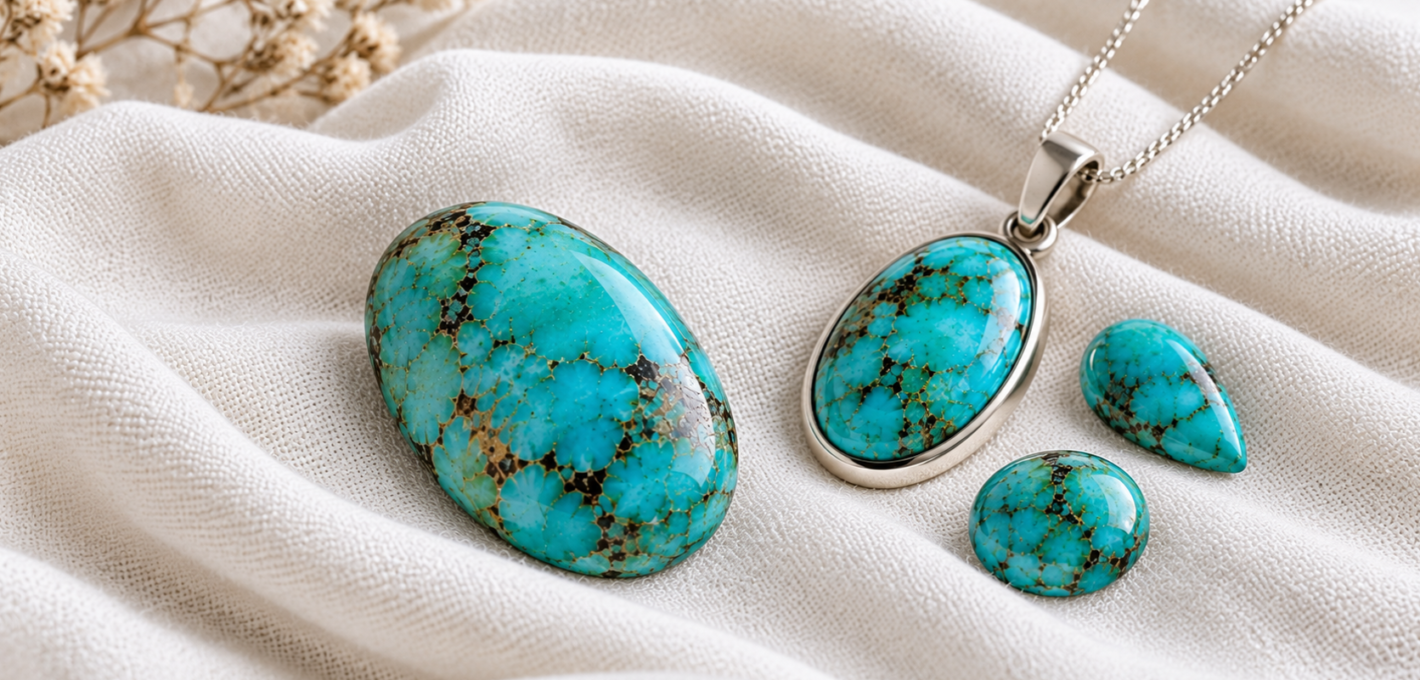
Genuine turquoise shows natural variation — slight color differences, veining (the darker matrix lines running through the stone), and surface texture that reflects its geological origin. Imitation materials tend to look too uniform, too perfectly colored, and too consistent across multiple pieces.
Check the Matrix
The dark veining or matrix visible in most turquoise is a characteristic feature of genuine stone — formed by the surrounding rock in which turquoise grows. Furthermore, the pattern of matrix varies between turquoise sources — experienced buyers can often identify the origin of genuine turquoise from its matrix character.
Temperature Test
Like all genuine gemstones, real turquoise feels cool to the touch and warms slowly in the hand. Plastic imitations warm quickly. Glass imitations also warm faster than genuine stone. Hold the suspected piece in your palm for 30 seconds — genuine turquoise stays noticeably cool longer.
Professional Verification
For significant purchases, request gemological testing. Genuine turquoise has a specific refractive index and specific gravity that laboratory testing can confirm definitively. Furthermore, request treatment disclosure in writing from any wholesale supplier — a reputable supplier discloses stabilization or other treatments on every invoice as standard practice.
Turquoise Jewelry Styles — What Works Best
Cabochon Settings
Turquoise is almost always cut as a cabochon — a smooth, domed surface without facets. This cut is standard for turquoise because it showcases the stone’s color and matrix most effectively. Furthermore, the smooth dome surface is appropriate for turquoise’s moderate hardness — faceted cuts would expose sharp edges that chip more easily.
Round, oval, and freeform cabochons are all popular. Freeform turquoise — cut to follow the natural shape of the rough material rather than standardized geometric shapes — creates one-of-a-kind pieces where each stone is unique.
Silver Settings
Turquoise and silver are one of the most iconic material combinations in jewelry history. The cool white metal of 925 sterling silver complements the blue-green of turquoise perfectly — providing contrast without competing for visual attention.
Oxidized silver settings — where the silver is intentionally darkened to a warm brown-black — are particularly popular with turquoise. The dark oxidized metal makes the turquoise color appear more vivid. Furthermore, this combination defines the aesthetic of Southwestern, Native American-inspired, and bohemian jewelry traditions worldwide.
Gold Vermeil Settings
Turquoise also pairs beautifully with gold vermeil settings — particularly yellow gold vermeil. The warm gold tone creates a richer, more luxurious aesthetic than silver. This pairing is particularly popular in Middle Eastern, Mediterranean, and contemporary bohemian luxury jewelry styles.
Setting Styles for Turquoise
Bezel setting is the most appropriate and most common setting for turquoise jewelry. The metal rim surrounds the stone completely — protecting the relatively soft turquoise from impact and chipping. Furthermore, bezel settings suit the organic aesthetic of turquoise beautifully.
Prong settings are less ideal for turquoise due to the stone’s moderate softness — exposed edges between prongs are vulnerable to chipping. However, low-profile prong settings with adequate metal coverage work acceptably for pendants and earrings where impact risk is lower.
Turquoise Care Guide
Turquoise requires careful handling and cleaning — its porosity and moderate hardness demand a gentler approach than harder, non-porous gemstones.
Cleaning Turquoise Jewelry
Wipe turquoise gently with a soft, slightly damp cloth — nothing more. Avoid soaking turquoise in water or any cleaning solution. Furthermore, avoid ultrasonic cleaners and steam cleaning — both can damage natural and stabilized turquoise. Never use chemical jewelry cleaners or silver polishing compounds directly on turquoise.
Avoiding Damage
Remove turquoise jewelry before bathing, swimming, or any water exposure. Keep turquoise away from perfume, hairspray, lotion, and hand sanitizer — the chemicals in these products penetrate the porous stone and cause permanent discoloration. Furthermore, store turquoise separately from harder gemstones that can scratch its relatively soft surface.
Storage
Store turquoise pieces individually in soft pouches — away from direct sunlight and heat. Prolonged UV exposure can fade some turquoise varieties over time. Additionally, extreme dryness can affect some natural turquoise — avoid storing near heat sources.
FAQs — Turquoise Stone Benefits and Jewelry
What are the main turquoise stone benefits?
Turquoise stone benefits in crystal healing tradition include protection from negative energy, support for clear communication and self-expression, emotional healing and balance, enhanced intuition, and spiritual connection. It is associated with the throat chakra and has been valued as a protective and healing stone across cultures for over 6,000 years.
Is turquoise good for daily wear?
Turquoise can be worn daily with appropriate care — remove before bathing, swimming, and applying personal care products. Stabilized turquoise is more durable for daily wear than natural untreated material. Bezel settings provide better protection than prong settings for daily-wear turquoise rings and bracelets.
How do I know if my turquoise is real?
Real turquoise shows natural color variation and matrix veining, feels cool to the touch, and carries meaningful weight. Imitation materials tend to look too uniform. For significant purchases, request treatment disclosure documentation from the seller and gemological testing for definitive verification.
What is the best metal to pair with turquoise?
925 sterling silver — particularly oxidized silver — is the most classic and most popular metal pairing for turquoise in jewelry. Gold vermeil is a beautiful alternative for a more luxurious aesthetic. Both complement turquoise’s blue-green color beautifully.
Does turquoise fade over time?
Some turquoise — particularly lower-grade natural material — can change color over time with exposure to light, oils, chemicals, and moisture. Stabilized turquoise is significantly more resistant to color change. Keep turquoise away from chemicals, prolonged sunlight, and moisture for maximum color longevity.
What chakra does turquoise work with?
Turquoise primarily works with the throat chakra — supporting communication, truth, and self-expression. It also has associations with the third eye chakra for intuition and the heart chakra for emotional healing, making it one of the most versatile chakra stones available.
Eon Gems — Natural Turquoise Jewelry Manufacturer in Jaipur
At Eon Gems, natural turquoise is one of our most consistently sourced and most popular stones for gemstone jewelry manufacturing. Based in Jaipur — the world’s largest colored gemstone trading hub — we source directly from established traders with full treatment disclosure as standard.
What we offer turquoise jewelry brands:
- Natural turquoise — stabilized and higher-grade natural material
- Full treatment disclosure on every stone as standard
- Freeform, round, and oval cabochon cuts available
- Bezel and freeform settings in 925 sterling silver and gold vermeil
- No MOQ — single prototype to large bulk production
- Complete export documentation for all major markets
- 36+ years of gemstone sourcing and manufacturing experience
👉 Get a Free Quote from Eon Gems →
🔗 Gemstone Jewelry Manufacturing →
🔗 925 Sterling Silver Jewelry →
🔗 Gold Vermeil Jewelry →