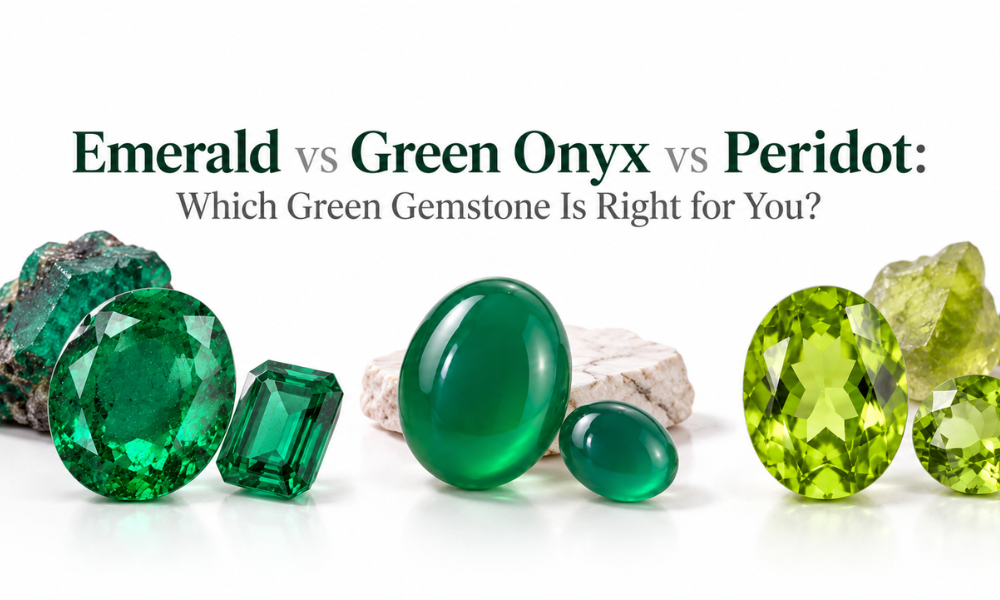
Green gemstones are among the most popular and most diverse categories in jewelry — but not all green stones are the same.
Emerald, green onyx, and peridot are three of the most widely used green gemstones in jewelry manufacturing. Each has a distinct color character, a different durability profile, a different price point, and a different aesthetic personality. Choosing between them is not simply a matter of picking your favorite shade of green — it is a decision that affects the entire design, pricing, and market positioning of the finished piece.
At Eon Gems, we are Jaipur-based gemstone jewelry manufacturers with 36+ years of experience sourcing and setting all three stones for jewelry brands and wholesale buyers worldwide. This complete guide gives you everything you need to make the right choice.
Emerald — The Queen of Green Gemstones
Emerald is a green variety of beryl — one of the most prestigious and historically significant gemstones in the world. Its rich, vivid green color comes from chromium and vanadium within the crystal structure. Furthermore, no other green gemstone produces quite the same depth and intensity of color that fine emerald achieves.
Emerald Color
Emerald color ranges from light green to deep, vivid bluish-green. The most valued stones show a medium to medium-dark tone with strong, vivid saturation and a slightly bluish-green hue. This specific color — often described as “emerald green” — is one of the most recognizable and commercially powerful colors in all of gemology.
Colombian emeralds are widely considered the finest in the world — their characteristic warm, vivid green with slight yellow undertones commands the highest premiums. Zambian emeralds typically show a cooler, slightly more bluish-green tone. Brazilian and Ethiopian emeralds offer good quality at more accessible price points.
Emerald Durability
Emerald rates 7.5 to 8 on the Mohs hardness scale — adequate for jewelry use. However, durability is more complex than hardness alone. Most natural emeralds contain internal fractures called “jardin” (French for garden) — these inclusions are so characteristic of emerald that gemologists consider them part of the stone’s identity.
These natural fractures make emerald more susceptible to chipping than its hardness rating suggests. Consequently, bezel settings are strongly recommended for emerald rings and bracelets. Prong settings expose the stone’s edges and increase chipping risk under daily wear conditions.
Emerald Treatments
Most natural emeralds undergo oil treatment — fractures are filled with cedar oil or synthetic resin to improve clarity and stability. This treatment is universally accepted in the trade and must be disclosed. Furthermore, untreated emeralds of fine quality command significant premiums over equivalent treated material.
Emerald Price
Emerald is the most expensive of the three stones in this comparison — often dramatically so at fine quality levels.
Commercial grade natural emerald: $20 to $100 per carat. Good grade (eye-clean or near, good color): $100 to $500 per carat. Fine grade (vivid color, eye-clean, minimal treatment): $500 to $5,000+ per carat. Colombian fine grade unheated: $2,000 to $20,000+ per carat.
Lab-grown emerald: $3 to $25 per carat — chemically identical to natural, typically better clarity, and dramatically lower price. An excellent choice for brands wanting the emerald aesthetic at accessible retail price points.
Emerald Meaning and Symbolism
Emerald carries rich cultural and spiritual associations accumulated over thousands of years. Ancient Egyptians considered it a symbol of eternal youth and rebirth. Cleopatra famously prized emerald above all other gemstones. Furthermore, in Vedic astrology, emerald (Panna) is associated with the planet Mercury — governing intelligence, communication, and business success.
Crystal healers associate emerald with the heart chakra — connecting it with love, compassion, and emotional healing. Additionally, it is associated with abundance, prosperity, and new beginnings — making it a popular choice for intention-setting jewelry.
Green Onyx — The Bold and Accessible Green
Green onyx is a dyed variety of chalcedony — a microcrystalline quartz mineral. Natural onyx comes in black, white, and various banded varieties. The vivid green color of “green onyx” results from dyeing — the stone’s natural porosity allows color to penetrate deeply and evenly, producing a stable, consistent green appearance.
Green Onyx Color
Green onyx offers a bold, vivid, highly saturated green color that is distinctive and immediately striking. Unlike emerald’s warm, nuanced green, green onyx tends toward a pure, clean green with excellent color consistency across a batch — making it ideal for jewelry designs where color uniformity across multiple pieces matters.
The color can range from medium green to deep forest green depending on the dyeing process. Furthermore, the consistent color distribution in green onyx means two stones of the same grade will match closely — a significant advantage for bridesmaid sets, pavé work, and any application requiring multiple matched stones.
Green Onyx Durability
Chalcedony rates 6.5 to 7 on the Mohs hardness scale — perfectly adequate for most jewelry applications. Furthermore, chalcedony has good toughness — it lacks the internal fractures that make emerald more fragile than its hardness suggests. Consequently, green onyx is more forgiving in daily wear than emerald.
The dyeing treatment is stable under normal wear conditions. However, exposure to harsh chemicals, prolonged soaking, and extreme heat can affect the dye over time. Consequently, standard jewelry care guidance applies — remove before bathing, avoid chemical exposure.
Green Onyx Treatments
All commercial green onyx is dyed — this is standard industry practice and must be disclosed. The dyeing process is stable and accepted in the trade. Furthermore, some green onyx undergoes additional stabilization treatments to improve durability. These treatments should also be disclosed by the supplier.
At Eon Gems, treatment disclosure is standard on every gemstone invoice — including dye treatment status on all green onyx orders.
Green Onyx Price
Green onyx is the most affordable of the three stones in this comparison — making it an excellent choice for brands targeting accessible price points without sacrificing visual impact.
Commercial to good grade green onyx in calibrated sizes: $0.50 to $5 per stone. Larger freeform and statement pieces: $5 to $30 per stone depending on size and quality. This affordability makes green onyx particularly attractive for high-volume collections, bridesmaid sets, and designs where multiple stones appear in a single piece.
Green Onyx Meaning and Symbolism
Green onyx carries associations with strength, endurance, and grounding energy in crystal healing tradition. Practitioners associate it with the heart chakra — connecting it with emotional resilience and stability rather than the romantic love associations of rose quartz. Furthermore, green onyx is associated with decision-making clarity and the ability to hold firm under pressure.
Additionally, the bold green color connects green onyx to growth, nature, and vitality in the symbolic language of color — making it a popular choice for brands building collections around nature, wellness, and strength themes.
Peridot — The Luminous Lime Green
Peridot is a gem-quality variety of the mineral olivine. It is one of the few gemstones that occurs in only one color — green — ranging from yellowish-green to vivid lime green to slightly brownish-green. The color comes from iron within the crystal structure rather than trace impurities. Furthermore, peridot is one of the few gemstones that forms in the Earth’s mantle rather than the crust — giving it a genuinely unusual geological origin.
Peridot Color
Peridot’s color is distinctive and immediately recognizable — a bright, slightly yellowish or lime green that looks unlike any other gemstone. The most valued color is a vivid, pure green without excessive yellow or brown. Fine peridot from Myanmar (Burma) and Pakistan shows the most saturated, pure green color and commands premiums over material from other sources.
The vivid lime green of peridot is particularly effective in contemporary and bohemian jewelry design — it photographs vividly in natural light and has a summery, energetic quality that sets it apart from the deeper, more formal greens of emerald and green onyx.
Peridot Durability
Peridot rates 6.5 to 7 on the Mohs hardness scale — comparable to green onyx. However, peridot has a relatively low resistance to thermal shock — it can crack under sudden temperature changes. Furthermore, it has lower toughness than many gemstones due to its crystal structure. Consequently, peridot is best suited for pendants, earrings, and low-impact jewelry applications. Daily-wear rings in peridot require protective settings and more careful handling.
Peridot Treatments
Peridot is one of the few gemstones that typically receives no treatment — what you see is the natural stone in its unenhanced state. This is a genuine commercial advantage in markets where natural, untreated stones carry premium appeal. Furthermore, the absence of treatment simplifies disclosure requirements and builds consumer trust.
Peridot Price
Peridot is moderately priced — more expensive than green onyx but significantly more accessible than fine natural emerald.
Commercial grade peridot in calibrated sizes: $2 to $10 per carat. Good grade (vivid color, eye-clean or near): $10 to $30 per carat. Fine grade (vivid pure green, eye-clean): $30 to $80 per carat. Fine Pakistani or Burmese peridot: $50 to $150+ per carat.
Peridot Meaning and Symbolism
Peridot carries some of the oldest healing associations of any gemstone — ancient Egyptians called it the “gem of the sun” and believed it protected against evil spirits and nightmares. Furthermore, Hawaiian tradition considers peridot the tears of the volcano goddess Pele — reflecting the stone’s volcanic geological origin.
In crystal healing tradition, practitioners associate peridot with the heart chakra and solar plexus chakra. They believe it promotes positivity, confidence, and abundance. Additionally, peridot is associated with releasing negative patterns and emotional baggage — creating space for growth, positivity, and new beginnings.
Emerald vs Green Onyx vs Peridot — Direct Comparison
Color Character
Emerald offers the deepest, most complex green — warm, rich, and prestigious. It communicates luxury and heritage. Green onyx offers bold, consistent, vivid green — striking and uniform. It communicates confidence and contemporary style. Peridot offers bright, lime green — fresh, luminous, and energetic. It communicates vitality and natural beauty.
Each color serves different design purposes and different market positioning. Furthermore, each photographs differently — emerald’s depth reads as luxurious in product photography, green onyx’s consistency creates strong visual impact in lifestyle photography, and peridot’s brightness performs exceptionally well in natural light photography.
Durability Comparison
Emerald is the hardest of the three (7.5 to 8 Mohs) but the most fragile due to natural inclusions. Consequently, emerald requires the most protective settings and the most careful handling in daily wear applications.
Green onyx (6.5 to 7 Mohs) has good toughness without the internal fracture concerns that affect emerald. It is more forgiving for daily wear than emerald despite its slightly lower hardness rating.
Peridot (6.5 to 7 Mohs) is comparable to green onyx in hardness but has lower resistance to thermal shock and lower toughness. Consequently, peridot is best suited for pendants and earrings rather than daily-wear rings.
Price Comparison
Green onyx is the most affordable option — typically $0.50 to $5 per stone in calibrated sizes. Peridot sits in the middle — $2 to $30 per carat for commercial to good grade. Natural emerald is the most expensive — starting at $20 per carat for commercial grade and reaching thousands per carat at fine quality. Lab-grown emerald, however, is competitive with good-grade peridot at $3 to $25 per carat.
Setting Recommendations
Emerald: Bezel settings strongly recommended for rings. Prong settings acceptable for pendants and earrings where impact risk is lower. Furthermore, avoid thermal shock during repair — oil-treated emerald is sensitive to heat.
Green onyx: Works well in all standard setting styles — prong, bezel, pavé, channel. The stone’s toughness makes it forgiving across applications. Additionally, its consistent color makes it ideal for pavé work where multiple stones must match closely.
Peridot: Best in protective settings — bezel or low-profile prong. Most appropriate for pendants and earrings. Avoid ultrasonic cleaning and steam cleaning. Furthermore, keep away from sudden temperature changes during jewelry repair.
Which Green Gemstone Is Right for Your Jewelry Brand?
Choose Emerald If
Your brand targets the premium or fine jewelry segment. Your retail price point supports $150 to $500+ per piece. You want the most prestigious green gemstone with centuries of cultural significance. Furthermore, you are selling to markets where natural gemstone provenance and rarity matter — Middle Eastern, Asian, or high-end Western fine jewelry markets.
Lab-grown emerald is an excellent choice if you want the emerald aesthetic at accessible price points. It delivers identical color and chemical properties at dramatically lower cost. Consequently, it opens the emerald category to brands targeting the $60 to $150 retail segment.
Choose Green Onyx If
Your brand targets accessible to mid-market price points. Your retail price point is $30 to $100 per piece. You need color consistency across multiple pieces — bridesmaid sets, matching collections, pavé designs. Furthermore, you want a bold, striking green that photographs with maximum visual impact for social media and e-commerce.
Green onyx is also the right choice for high-volume collections where stone cost is a significant margin factor. Additionally, its durability profile makes it practical for a wider range of jewelry applications than peridot.
Choose Peridot If
Your brand aesthetic is natural, bohemian, or summer-inspired. Your retail price point is $50 to $150 per piece. You want a gemstone that requires no treatment disclosure — peridot’s natural, untreated status is a genuine commercial advantage in markets where natural origin matters. Furthermore, peridot’s lime green color fills a specific aesthetic niche that neither emerald nor green onyx occupies.
Additionally, peridot is the August birthstone — making it an excellent choice for brands building birthstone collections. The birthstone category drives consistent demand regardless of broader trend cycles.
Consider All Three If
Your brand builds collections across multiple green stone varieties — offering emerald for premium pieces, peridot for mid-range natural stone pieces, and green onyx for accessible high-impact designs. This approach covers the full green gemstone market from accessible to fine without requiring customers to choose between green and budget.
Setting Green Gemstones in Silver and Vermeil
All three green gemstones work beautifully in both 925 sterling silver and gold vermeil settings — but each has optimal metal pairings.
Silver Settings
Sterling silver’s cool white tone complements the green of all three stones without competing for attention. Oxidized silver creates particularly dramatic contrast — the dark metal makes green stones appear more vivid. This pairing suits artisan, bohemian, and nature-inspired aesthetics strongly. Furthermore, plain polished silver suits minimalist and contemporary designs equally well.
Gold Vermeil Settings
Yellow gold vermeil creates a warm, rich contrast with deep emerald green — echoing the historical use of gold and emerald together in royal and ecclesiastical jewelry. Green onyx against yellow gold vermeil creates bold, contemporary luxury aesthetic. Peridot against yellow gold vermeil creates a warm, summery combination that suits the stone’s lime green character.
Rose gold vermeil pairs particularly well with lighter peridot and lighter emerald varieties — the warm pink tone creates a soft, feminine aesthetic that works strongly in the romantic jewelry market.
FAQs — Emerald vs Green Onyx vs Peridot
Which is more valuable — emerald, green onyx, or peridot?
Natural emerald is significantly more valuable than both green onyx and peridot at equivalent quality. Fine natural emerald commands some of the highest per-carat prices in the colored gemstone market. Green onyx is the most affordable. Peridot sits in the middle — more expensive than green onyx but far more accessible than fine natural emerald.
Which green gemstone is most durable for daily wear?
Green onyx is the most practical for daily wear — its toughness and lack of internal fractures make it more forgiving than emerald despite comparable hardness. Emerald is harder but more fragile. Peridot’s lower toughness and thermal sensitivity make it the least suitable for daily-wear rings. However, all three work well in pendants and earrings.
Is green onyx a natural stone?
Green onyx is natural chalcedony — a genuine natural gemstone — but its green color comes from dyeing. Natural chalcedony does not occur in vivid green. The dyeing treatment is standard industry practice and must be disclosed. Consequently, green onyx should always be represented accurately as a dyed natural stone.
Is lab-grown emerald a good alternative to natural emerald?
Yes — lab-grown emerald is chemically identical to natural emerald with identical color and optical properties. It typically shows better clarity than equivalent natural material and costs 60 to 90% less. For jewelry brands wanting the emerald aesthetic at accessible retail price points, lab-grown emerald is an excellent choice. However, natural emerald retains significant premiums in markets where natural origin and rarity matter.
Which stone is best for spiritual or crystal healing jewelry?
All three stones carry healing associations — emerald with heart chakra, love, and abundance; green onyx with strength, grounding, and resilience; peridot with positivity, confidence, and natural vitality. The right choice depends on your brand’s spiritual positioning and the specific intentions your collection is designed to support.
Eon Gems — Green Gemstone Jewelry Manufacturer in Jaipur
At Eon Gems, emerald, green onyx, and peridot are all part of our extensive in-house gemstone jewelry manufacturing range. Based in Jaipur — the world’s largest colored gemstone trading hub — we source all three stones directly from established traders with full treatment disclosure as standard.
What we offer:
- Natural emerald — commercial to fine grade, Colombian, Zambian, Brazilian
- Lab-grown emerald — excellent clarity, vivid color, accessible pricing
- Green onyx — calibrated and freeform, full treatment disclosure
- Peridot — natural untreated, calibrated and freeform cuts
- All stones set in 925 sterling silver and gold vermeil
- No MOQ — single prototype to large bulk production
- Complete export documentation for all major markets
- 36+ years of gemstone sourcing and manufacturing experience
👉 Get a Free Quote from Eon Gems →
🔗 Gemstone Jewelry Manufacturing →
🔗 925 Sterling Silver Jewelry →
🔗 Gold Vermeil Jewelry →