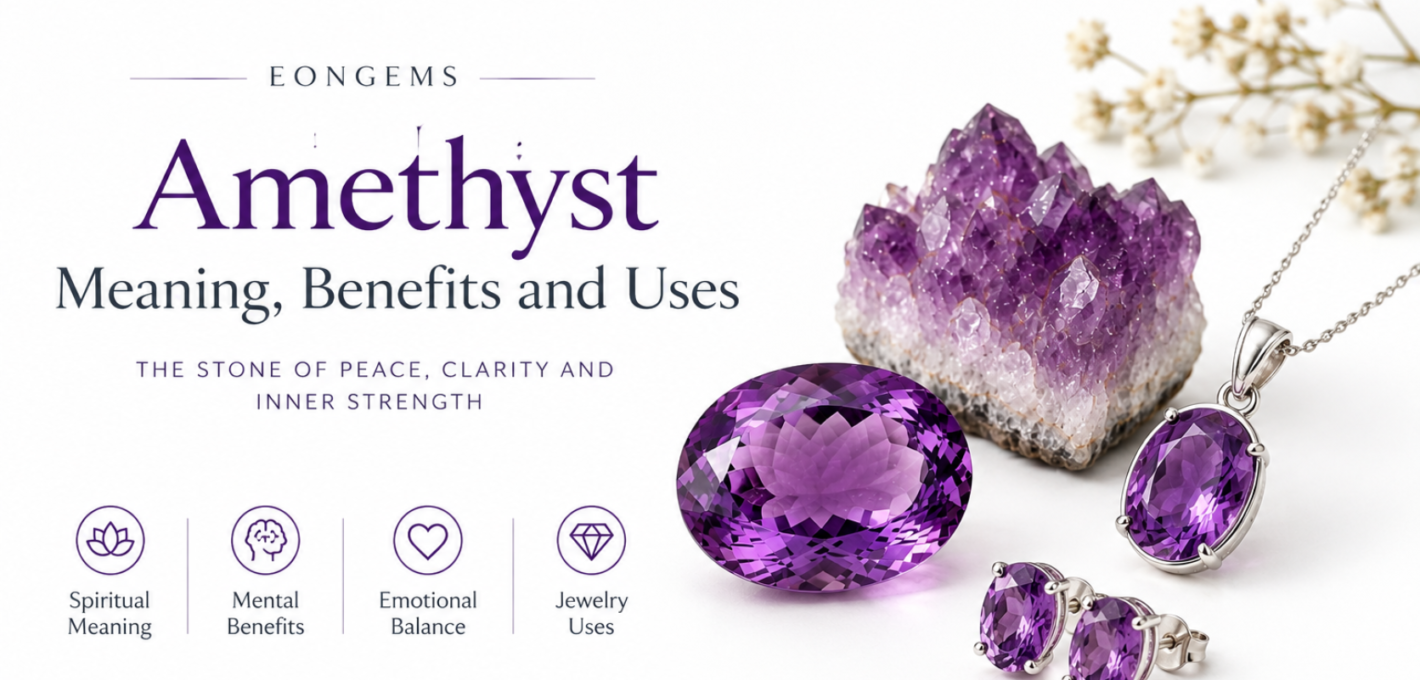
Amethyst is the world’s most popular purple gemstone — and one of the most widely used healing crystals in modern spiritual practice.
For thousands of years, cultures across the world have treasured amethyst for its striking violet color, its calming energy, and its deep associations with spiritual wisdom and protection. From ancient Greek symposia to medieval European royalty, from Vedic astrology to contemporary crystal healing — amethyst has never lost its significance.
At Eon Gems, we are Jaipur-based gemstone jewelry manufacturers with 36+ years of experience sourcing and setting natural amethyst for jewelry brands and wholesale buyers worldwide. This complete guide covers amethyst meaning, healing benefits, chakra associations, and everything you need to know about amethyst in jewelry.
What Is Amethyst?
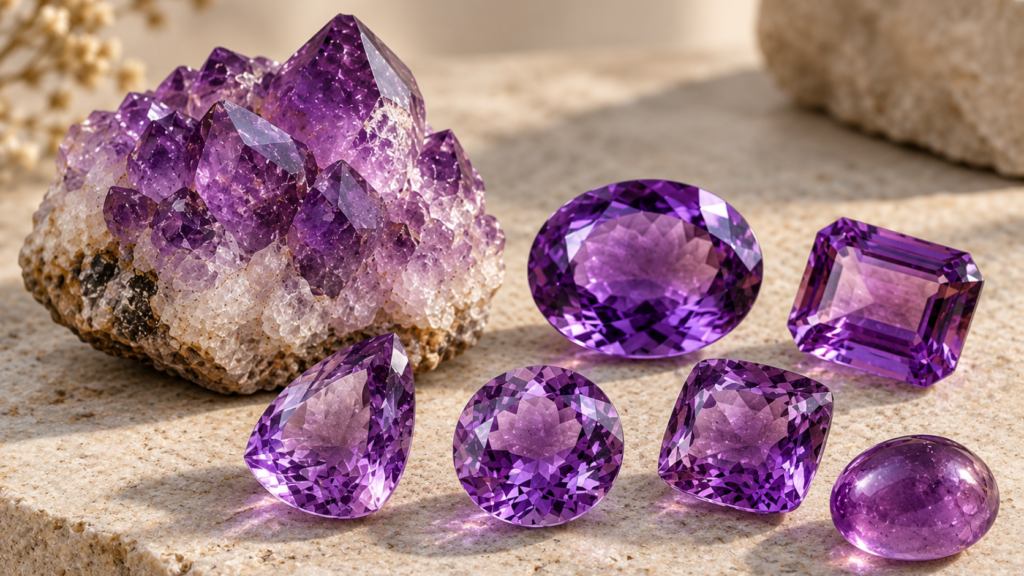
Amethyst is a violet variety of quartz — the same mineral family as citrine, smoky quartz, and rose quartz. Iron impurities and irradiation within the crystal structure give it the distinctive purple color. The color ranges from pale lilac to deep, rich violet. Medium to medium-dark vivid purple commands the highest value.
According to the GIA Gem Encyclopedia, amethyst rates 7 on the Mohs hardness scale — making it durable enough for all jewelry applications including rings, bracelets, and daily-wear pieces. Furthermore, it is widely available in calibrated cuts and freeform shapes. Consequently, it is one of the most accessible gemstones for jewelry manufacturing at scale.
The finest amethyst historically came from Siberia — the deep “Siberian amethyst” color remains the benchmark for fine material. Today, Brazil, Uruguay, Zambia, and Madagascar are the largest commercial sources. Zambian amethyst — known for its deep, slightly reddish-purple tone — is increasingly sought after by designers worldwide.
Amethyst Meaning — History and Symbolism
Ancient Greek and Roman Tradition
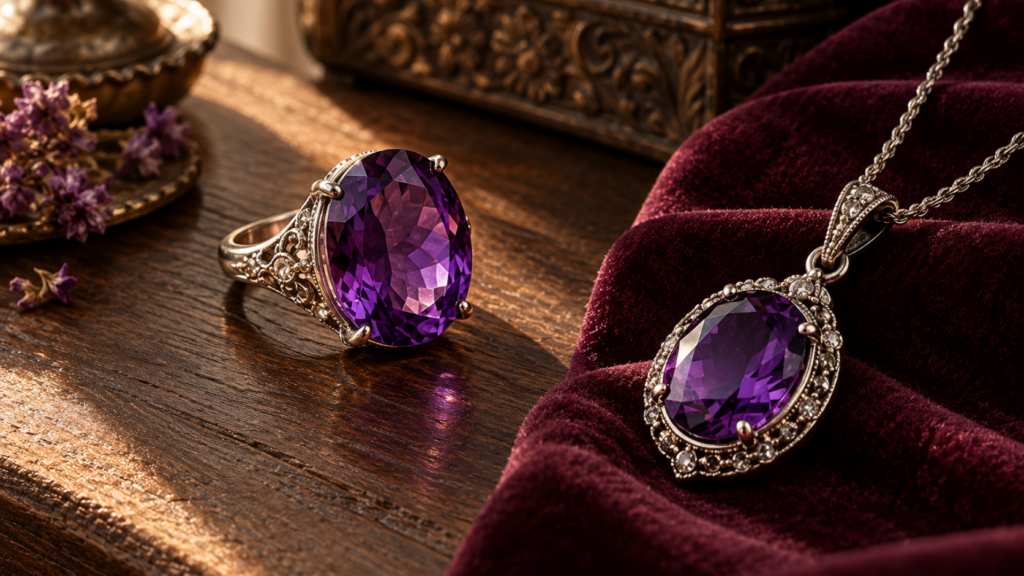
The name amethyst comes from the ancient Greek word “amethystos” — meaning “not intoxicated.” Ancient Greeks believed amethyst protected wearers from the effects of alcohol and promoted clear, sober thinking. Consequently, artisans carved wine goblets from amethyst, and people wore the stone at banquets as protection from intoxication.
Roman tradition carried similar associations — sobriety, clarity of mind, and protection from excess. Furthermore, soldiers wore amethyst amulets in battle. They believed the stone kept them clear-headed and protected in combat.
Medieval and Renaissance Europe
Throughout the medieval period, amethyst ranked among the most precious gemstones alongside diamond, ruby, sapphire, and emerald. Its purple color carried associations with royalty and the church. Catholic bishops traditionally wore amethyst rings — earning it the name “Bishop’s Stone.”
Furthermore, people believed it protected wearers from temptation and promoted devotional focus. St. Valentine reportedly wore an amethyst ring carved with the image of Cupid.
Vedic and Eastern Traditions
In Vedic astrology, amethyst carries associations with Saturn (Shani). Some astrologers recommend it as a complementary stone to blue sapphire for Saturn’s planetary influence. In Buddhist tradition, practitioners consider amethyst sacred. They use it in prayer beads and meditation objects throughout many Buddhist communities.
Amethyst Meaning in Crystal Healing
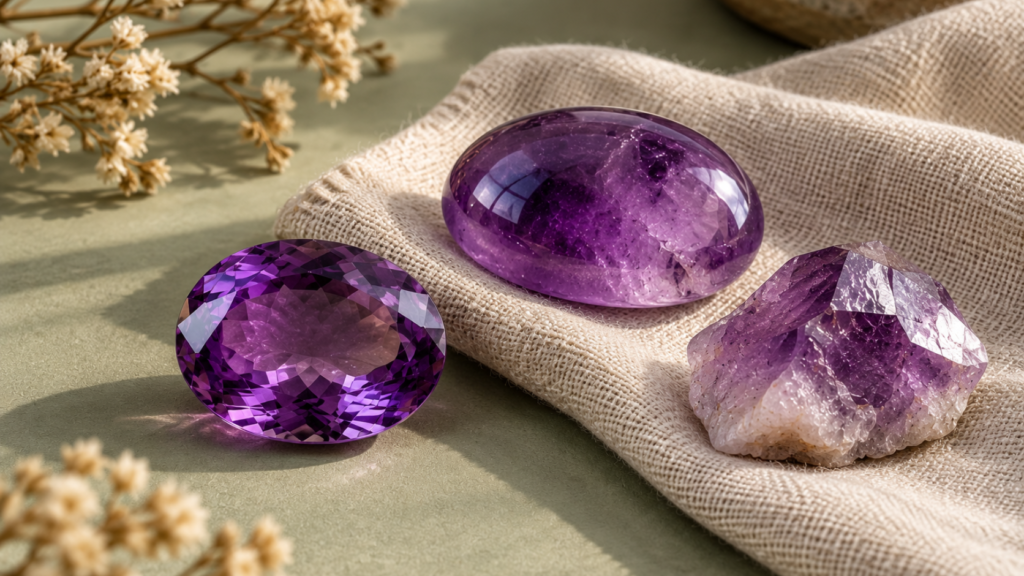
In modern crystal healing tradition, amethyst carries one of the richest and most multidimensional sets of associations of any stone.
Protection and Purification
Crystal healers consider amethyst one of the most powerful protection stones available. It creates a protective energy field around the wearer — shielding from negative energy, psychic attack, and environmental stress. Furthermore, practitioners associate it with clearing and purifying the energy field. As a result, many people wear amethyst specifically during periods of heightened stress or exposure to difficult environments.
Mental Clarity and Sobriety
Crystal healing tradition associates amethyst strongly with mental clarity — echoing its ancient Greek associations. Practitioners believe it calms an overactive mind and supports wise decision-making. Furthermore, crystal healers recommend it for overcoming addictive behaviors and patterns. They believe its calming influence creates space for healthier choices.
Spiritual Connection and Transformation
Crystal healers consider amethyst a gateway stone that opens awareness to higher wisdom and spiritual guidance. It carries strong associations with transformation — helping wearers release unhelpful patterns and create space for healthier ways of being. Additionally, practitioners associate it with emotional balance. They believe it stabilizes mood swings and supports wearers through grief, anxiety, and emotional turbulence.
Amethyst Benefits — Healing Properties
Mental and Emotional Benefits
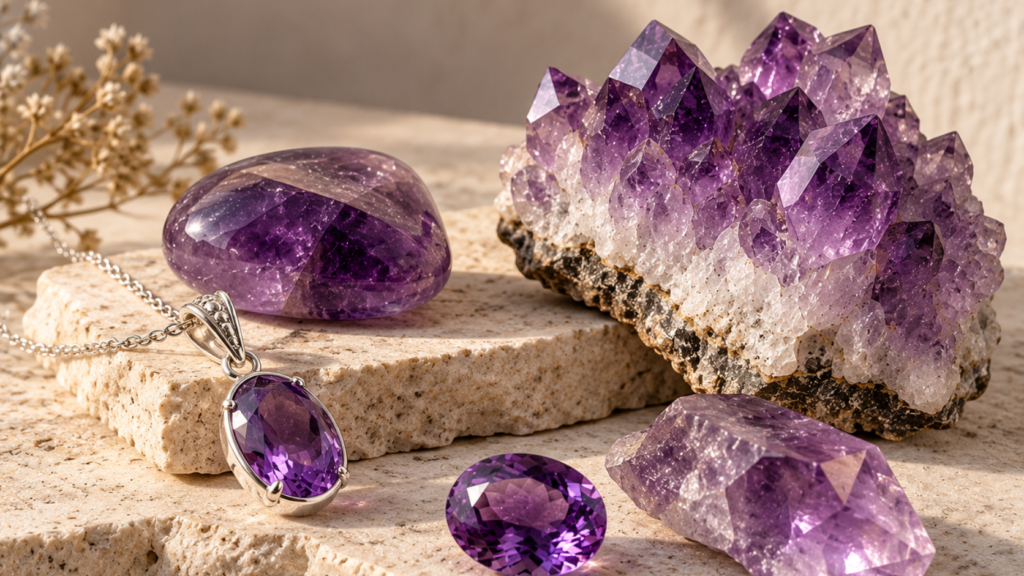
Amethyst is one of the most consistently recommended stones for mental and emotional wellbeing in crystal healing practice. Its calming energy reduces anxiety, quiets mental chatter, and promotes inner peace. Many practitioners recommend it specifically for people dealing with stress, overthinking, and sleep difficulties.
Furthermore, crystal healing tradition associates amethyst with improved focus and concentration. It promotes the kind of clear, calm mental state in which creative and intellectual work flows naturally. Additionally, practitioners recommend it for processing grief and loss — its gentle energy supports emotional pain without numbing genuine feeling.
Spiritual Benefits
Crystal healers widely consider amethyst the premier stone for meditation. Its calming energy quiets mental noise and supports focused, open awareness that deepens meditation practice. Furthermore, practitioners associate it with developing intuition and psychic awareness — opening the third eye chakra and supporting perception beyond ordinary sensory experience.
Dream work is another widely cited application. Placing amethyst near the bed supports vivid, meaningful dreams and lucid dreaming practice. Many crystal users report this as one of the most practically noticeable benefits of working with amethyst regularly.
Physical Healing Associations
Traditional crystal healing associates amethyst with several physical healing properties — though these come from healing tradition rather than modern medical evidence.
Crystal healers associate amethyst with headache relief — its calming effect on the nervous system reduces tension headaches and migraines in traditional practice. Furthermore, practitioners cite improved sleep quality as one of the most consistent practical benefits. Additionally, healers associate it with immune system support, hormonal balance, and relief from physical tension.
Protection Benefits
Protection is one of amethyst’s most ancient and consistent associations. Crystal healers believe it creates a shield of protective light — repelling negative energy, blocking psychic attack, and neutralizing environmental stress.
Furthermore, practitioners consider amethyst particularly protective during travel — maintaining a clear, calm energy field in environments where the wearer encounters many different energies. Crystal healers often recommend amethyst for empaths and highly sensitive people. They believe it helps regulate the absorption of others’ emotions.
Amethyst Chakra Associations
Crown Chakra — Primary Association
Crystal healers universally consider amethyst the quintessential crown chakra stone — the most widely recommended crystal for activating and balancing the Sahasrara, the seventh and highest chakra located at the top of the head.
The crown chakra governs spiritual connection, divine consciousness, and the sense of unity with all that exists. When balanced, it supports peace, purpose, and spiritual alignment. Amethyst’s violet color directly corresponds to the crown chakra’s color frequency. Therefore, crystal healers consider it one of the most naturally suited stones for this energy center.
Working with amethyst at the crown chakra deepens meditation, strengthens spiritual connection, and supports integration of spiritual insight into everyday life.
Third Eye Chakra — Secondary Association
Amethyst also resonates strongly with the third eye chakra (Ajna) — located between the eyebrows and governing intuition, perception, and inner wisdom.
Furthermore, the deep indigo-violet color of darker amethyst varieties bridges the violet of the crown and the indigo of the third eye. As a result, crystal healers often use amethyst to work with both chakras simultaneously in meditation and energy healing practices.
Amethyst in Jewelry — What Works Best
Settings for Amethyst
Amethyst’s Mohs 7 hardness makes it suitable for all jewelry types — including rings and bracelets that experience more daily friction than pendants and earrings. The stone has no cleavage, which means it does not chip along crystal planes the way some harder stones do. Consequently, amethyst is a practical and durable choice for everyday jewelry.
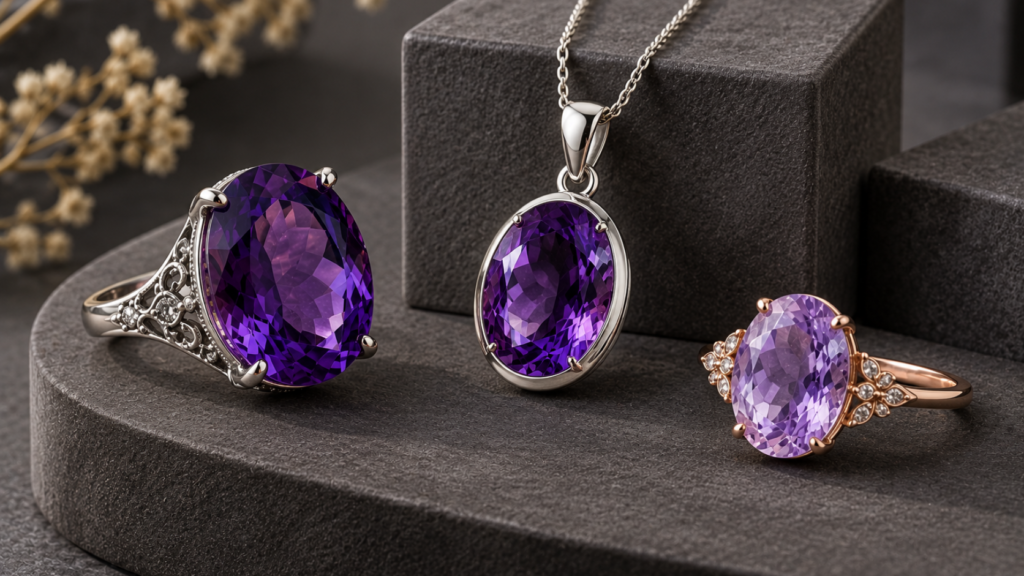
Prong settings showcase amethyst’s color and brilliance most effectively — allowing maximum light to enter and reflect within the stone. Bezel settings provide a more protective profile and suit organic and contemporary design aesthetics. Furthermore, freeform cabochon amethyst in bezel settings creates distinctive artisan pieces where each stone’s unique character takes center stage.
Metal Pairings
Amethyst’s cool violet tones pair beautifully with the bright white of 925 sterling silver — the classic and most popular pairing for amethyst jewelry worldwide. The cool silver tone complements and enhances the purple rather than competing with it.
Oxidized sterling silver creates a particularly dramatic setting for deep purple amethyst — the dark metal makes the violet color appear more vivid and intense. Furthermore, rose gold vermeil pairs beautifully with lighter lavender amethyst varieties. Yellow gold vermeil with deep amethyst creates a rich, regal aesthetic — echoing the historical association between purple and gold in royal tradition.
Popular Jewelry Styles
Amethyst point pendants — featuring a natural crystal point in a silver setting — are one of the most consistently popular amethyst jewelry styles in the spiritual and wellness market. The crystal point amplifies the stone’s energy associations and has strong visual appeal.
Faceted amethyst in oval or round brilliant cuts performs strongly in fine jewelry-adjacent designs. Solitaire rings, pendant necklaces, and drop earrings all showcase the stone’s color and brilliance effectively. Additionally, raw or rough amethyst in freeform bezel settings creates one-of-a-kind artisan pieces. These suit the bohemian and crystal healing market aesthetics strongly.
Amethyst Varieties — What’s Available
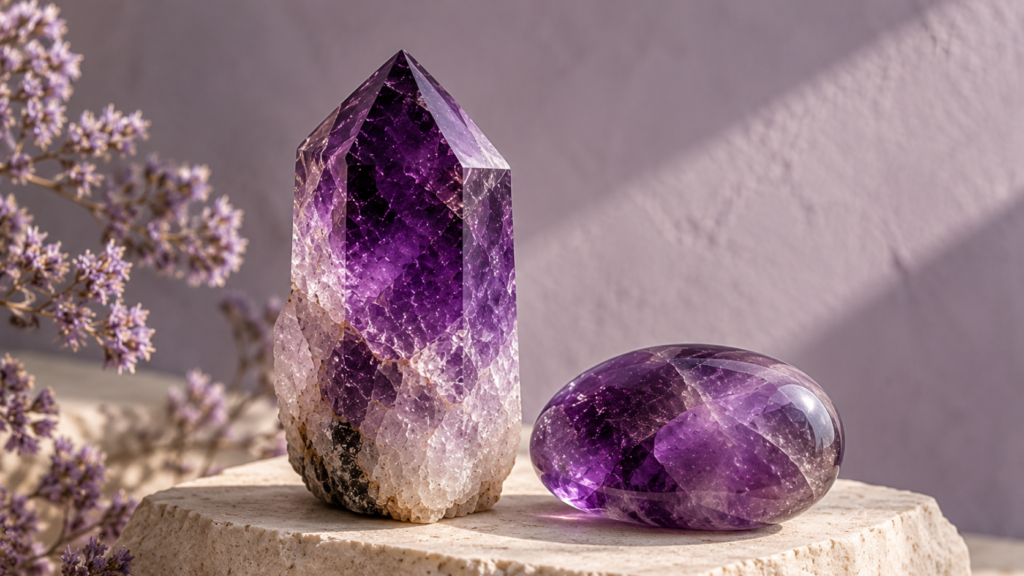
Deep Purple Amethyst
The most prized variety for fine jewelry applications — vivid, highly saturated purple with minimal grey or brown modifiers. Brazilian and Uruguayan deep purple amethyst is the most commonly available source for high-saturation material. Furthermore, Zambian amethyst’s characteristic reddish-purple tone attracts increasing interest from designers and collectors alike.
Lavender Amethyst
Pale lavender amethyst has its own dedicated market — particularly in romantic, feminine, and contemporary fine jewelry aesthetics. The softer color suits rose gold vermeil settings beautifully. Additionally, lavender amethyst is often more affordable than deep purple material. Therefore, it is an excellent choice for brands targeting accessible price points.
Chevron Amethyst
A variety showing alternating bands of white quartz and purple amethyst in a distinctive V-pattern. Crystal healing practitioners prize it for its combined energies of amethyst and white quartz. Furthermore, the banded pattern creates visual interest that suits freeform cabochon cuts particularly well.
Ametrine
A natural combination of amethyst and citrine in a single stone — showing both purple and golden yellow in distinct zones. Primarily found in Bolivia, ametrine is a genuinely rare natural phenomenon. Collectors prize it highly, and contemporary designers increasingly feature it in distinctive jewelry.
How to Use Amethyst
In Meditation
Place amethyst directly on the third eye or crown chakra during meditation — or hold a piece in each hand. Its calming energy supports the transition into meditative states. Furthermore, a large amethyst cluster or geode in the meditation space creates a supportive field of calm, clear energy throughout the room.
For Sleep
Place amethyst on the bedside table or under the pillow to support restful sleep and meaningful dreams. Many crystal users report that amethyst reduces the time it takes to fall asleep. Furthermore, practitioners recommend it for people who experience anxiety dreams — its calming energy promotes more peaceful dream states.
Wearing Amethyst Daily
Wearing amethyst as jewelry maintains its energy field in contact with the wearer throughout the day. Ring wearing brings the stone’s energy into the hands — associated with action and creation. Necklaces and pendants keep amethyst near the heart and throat — supporting emotional balance and clear communication. Furthermore, earrings position amethyst near the third eye and crown — supporting intuition and spiritual awareness.
In the Home
Amethyst clusters and geodes are among the most popular crystal décor items. Practitioners place them in living spaces to create calming, protective energy. Large amethyst geodes are particularly popular as statement décor pieces. They combine genuine energetic intention with striking visual presence — making them one of the most commercially successful crystal products in the wellness market.
Amethyst Care Guide
Cleaning
Clean amethyst jewelry with mild soap and lukewarm water using a soft brush. Rinse thoroughly and dry with a soft cloth. Amethyst is generally safe for gentle ultrasonic cleaning when the stone has no significant fractures. However, avoid steam cleaning — temperature extremes can affect some amethyst varieties.
Sun Sensitivity
Amethyst is sensitive to prolonged direct sunlight — UV exposure can fade the color of some varieties over time. This is particularly true for lighter lavender amethyst. Therefore, avoid displaying amethyst jewelry or crystal specimens in direct sunlight for extended periods. Store away from windows where ongoing UV exposure would occur.
Storage
Store amethyst pieces individually in soft pouches to prevent scratching from harder gemstones. Furthermore, keep pieces away from heat sources — extreme heat can cause color change in some amethyst varieties, particularly those with natural color zoning.
Amethyst Price Guide
Amethyst is one of the most accessible precious gemstones in the market — historically available at prices significantly lower than ruby, sapphire, or emerald of equivalent visual impact.
Commercial grade amethyst in calibrated cuts runs approximately $0.50 to $3 per carat. Good grade — medium to deep purple, eye-clean or near eye-clean — runs $3 to $15 per carat. Fine grade Zambian or deep Uruguayan amethyst runs $10 to $40 per carat. Large statement pieces in deep fine-grade material can reach $50 to $100+ per carat.
At Eon Gems, amethyst in multiple quality grades is available directly from Jaipur’s gem markets — with full treatment disclosure and origin documentation as standard for all gemstone orders.
FAQs — Amethyst Meaning, Benefits and Uses
What is the main amethyst meaning in crystal healing?
Crystal healing tradition centers amethyst’s meaning on three themes — spiritual protection, mental clarity, and spiritual connection. Practitioners consider it the premier crown chakra stone — associated with deepening meditation, developing intuition, and creating a protective energy field around the wearer. Furthermore, it is one of the most widely recommended stones for reducing anxiety and supporting restful sleep.
Which chakra does amethyst work with?
Amethyst primarily works with the crown chakra (Sahasrara) — associated with spiritual connection and divine consciousness. It also has strong associations with the third eye chakra (Ajna) — supporting intuition, inner vision, and psychic awareness.
Can amethyst be worn every day?
Yes — amethyst’s Mohs 7 hardness makes it suitable for daily wear in all jewelry types. Keep it away from harsh chemicals and prolonged direct sunlight to maintain its color. Furthermore, bezel settings provide better protection than prong settings for daily-wear amethyst rings and bracelets.
What is the best metal for amethyst jewelry?
925 sterling silver is the most classic and popular pairing — the cool white metal complements amethyst’s violet tones beautifully. Oxidized silver creates dramatic contrast with deep purple amethyst. Rose gold vermeil pairs beautifully with lavender amethyst varieties.
Does amethyst fade in sunlight?
Some amethyst varieties — particularly lighter lavender material — can fade with prolonged exposure to direct sunlight. Therefore, avoid displaying amethyst in sunny windows and store pieces away from ongoing UV exposure.
What is the difference between natural and synthetic amethyst?
Natural amethyst forms in the earth over millions of years and shows natural inclusions and color variation. Synthetic amethyst produces in a laboratory with identical chemical composition but typically shows too-perfect clarity and color consistency. For crystal healing purposes, most practitioners prefer natural amethyst — believing natural formation carries energetic properties that laboratory production does not replicate.
Eon Gems — Natural Amethyst Jewelry Manufacturer in Jaipur
At Eon Gems, natural amethyst is one of our most consistently available and most popular stones for gemstone jewelry manufacturing. Based in Jaipur — the world’s largest colored gemstone trading hub — we source directly from established traders with full treatment disclosure as standard.
What we offer amethyst jewelry brands:
- Natural amethyst — commercial, good, and fine grade available
- Multiple varieties — deep purple, lavender, Zambian, chevron
- Calibrated and freeform cuts — round, oval, cushion, point, raw
- Prong, bezel, and freeform settings in 925 sterling silver and gold vermeil
- No MOQ — single prototype to large bulk production
- Complete export documentation for all major markets
- 36+ years of gemstone sourcing and manufacturing experience
👉 Get a Free Quote from Eon Gems →
🔗 Gemstone Jewelry Manufacturing →
🔗 925 Sterling Silver Jewelry →
🔗 Gold Vermeil Jewelry →