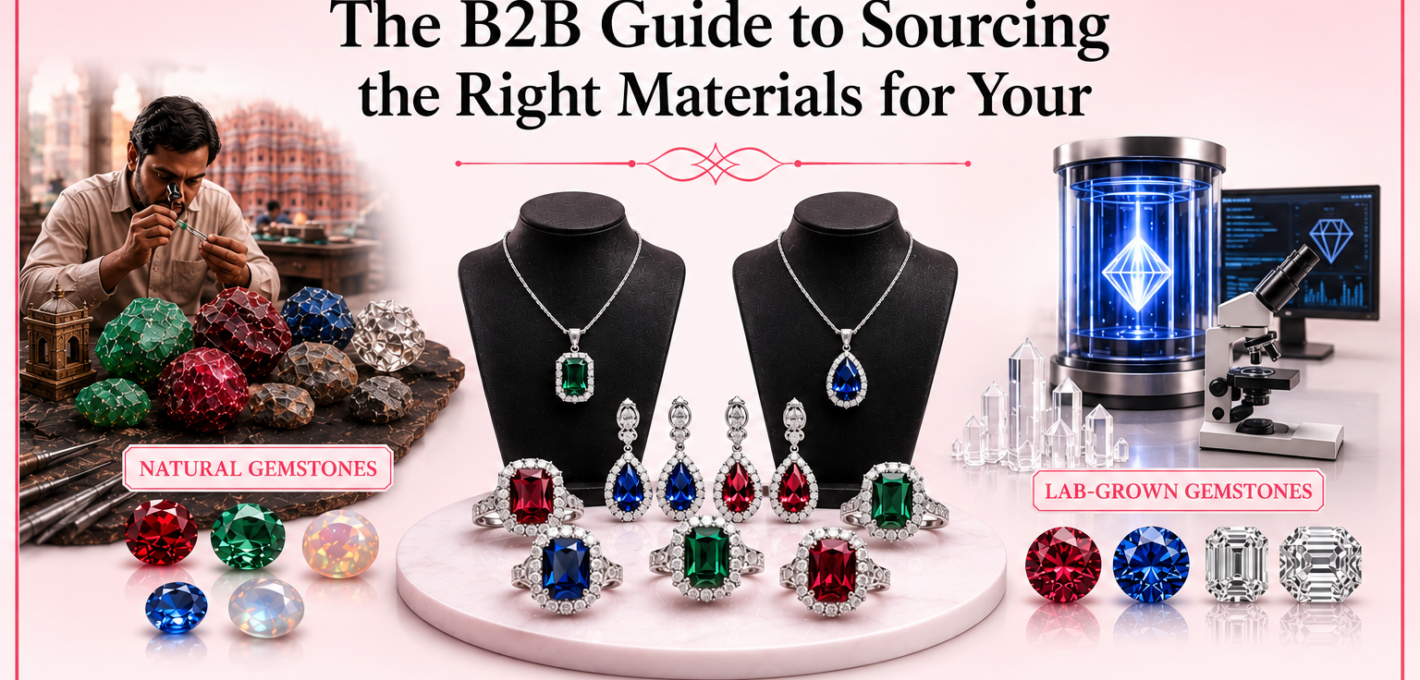
The gemstone sourcing landscape has changed dramatically in the last five years. Lab-grown gemstones — once a niche category — have moved firmly into the mainstream jewelry market, forcing every brand owner, wholesale buyer, and private-label importer to make a deliberate choice: natural, lab-grown, or both?
There is no universally correct answer. The right choice depends on your brand positioning, target customer, price point, and long-term business strategy. This guide gives you the complete B2B picture — so you can make the right sourcing decision before placing your next manufacturing order with a gemstone jewelry manufacturer.
What Are Natural Gemstones?
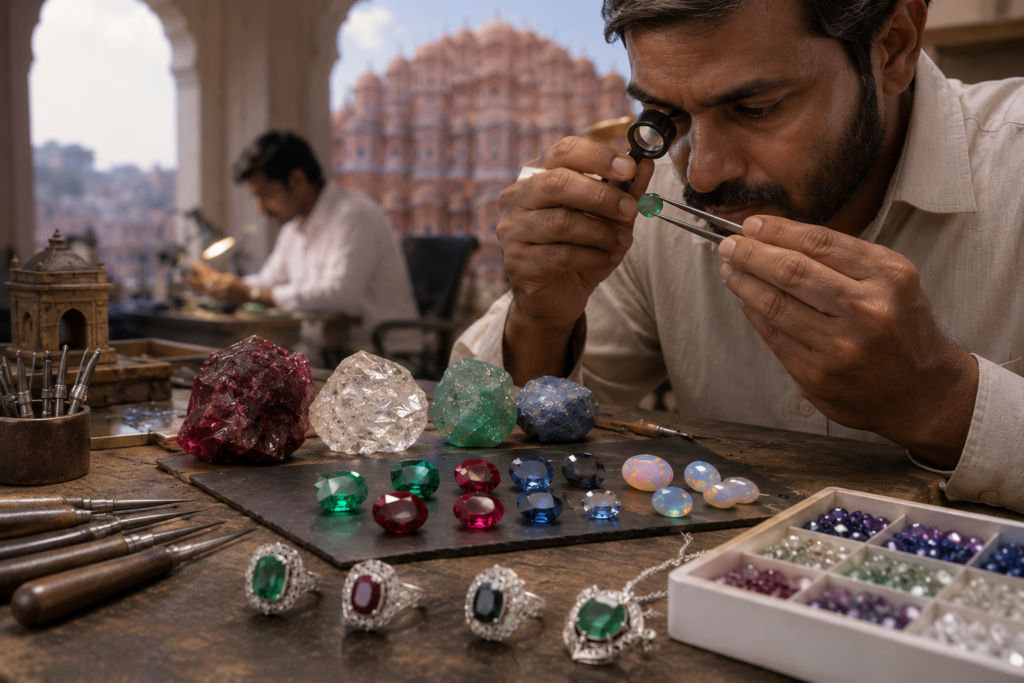
Natural gemstones are formed entirely by geological processes deep within the earth — without any human involvement in their creation. Heat, pressure, mineral-rich fluids, and millions of years combine to produce the crystalline structures that jewelry manufacturers cut, polish, and set into finished pieces.
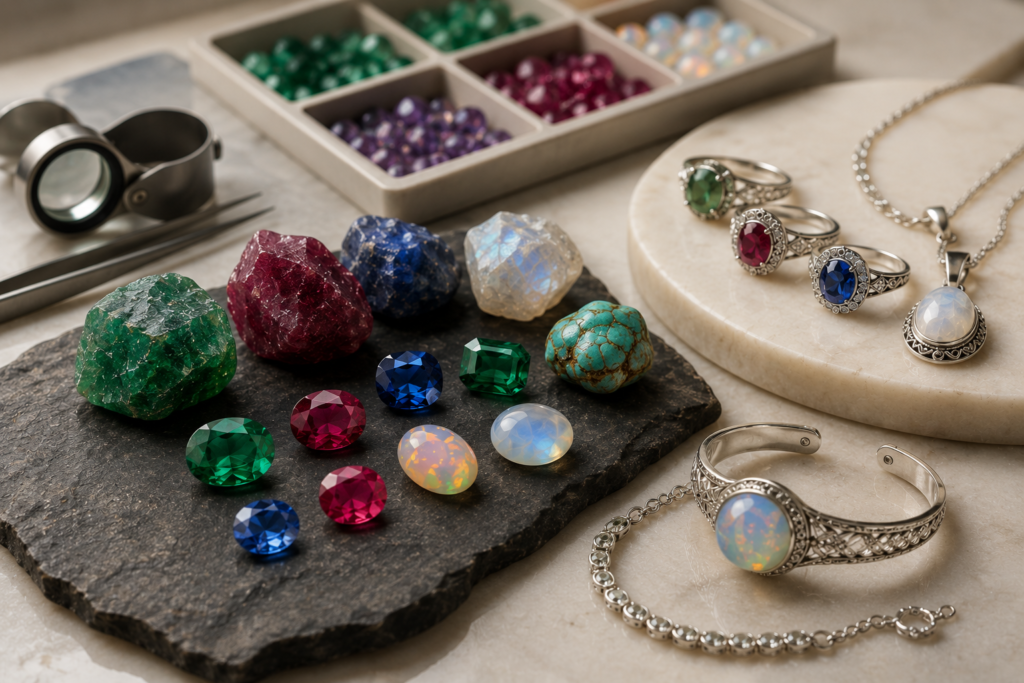
Every natural gemstone is unique. No two rubies share exactly the same color. No two opals display the same play of light. This natural variation — including inclusions, color zoning, and growth patterns — is considered part of the stone’s identity and is valued by collectors, connoisseurs, and premium buyers worldwide.
Natural gemstones commonly used in jewelry:
Emerald, ruby, sapphire, turquoise, moonstone, labradorite, Ethiopian opal, malachite, garnet, amethyst, citrine, peridot, aquamarine, coral, larimar, and hundreds more.
Jaipur — where Eon Gems is based — is the world’s largest trading hub for natural colored gemstones. Stones arrive from mines in Colombia, Zambia, Sri Lanka, Ethiopia, Afghanistan, and Brazil — cut, graded, and traded before being set into 925 sterling silver and gold vermeil jewelry in our in-house manufacturing facility.
What Are Lab-Grown Gemstones?
Lab-grown gemstones — also called synthetic, created, or cultured gemstones — are produced in controlled laboratory environments that replicate the natural conditions under which gemstones form in the earth.
The most important fact for B2B buyers to understand: lab-grown gemstones are chemically, physically, and optically identical to their natural counterparts. A lab-grown emerald has the same chemical composition, the same crystal structure, and the same refractive index as a mined emerald. The only difference is origin — one formed over millions of years in the earth, the other produced in weeks in a laboratory.
Common lab-grown gemstones used in jewelry:
Ruby, sapphire, emerald, moissanite, alexandrite, spinel, and lab-grown diamond.
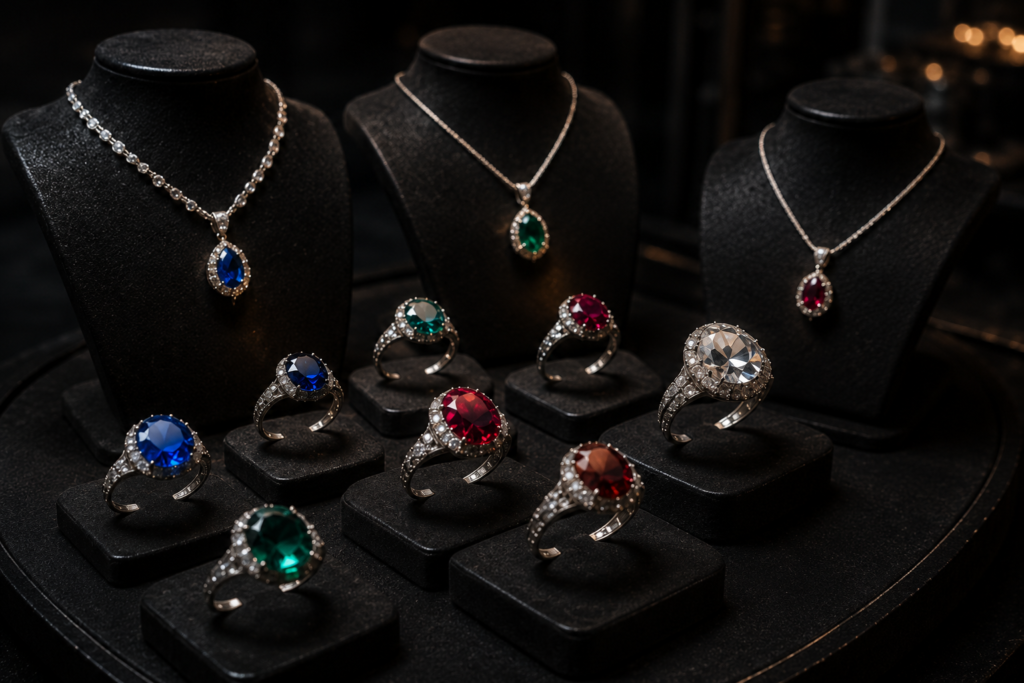
Natural vs. Lab-Grown Gemstones — Key Differences for B2B Buyers
1. Chemical and Physical Properties
Natural: Genuine geological origin with naturally occurring inclusions and growth characteristics. Gemologists use these characteristics to confirm natural origin and assess quality.
Lab-Grown: Chemically and physically identical to natural. Generally cleaner and more inclusion-free at equivalent price points — the controlled environment produces fewer growth irregularities.
B2B implication: For most jewelry applications, the physical difference between natural and lab-grown is negligible. The distinction matters primarily for certification, marketing, and customer perception — not product performance.
2. Price Difference
This is where the contrast is most dramatic — and most commercially significant.
Lab-grown gemstones cost 60–90% less than natural stones of equivalent size and visual quality, depending on the stone type.
B2B implication: For brands wanting to offer ruby, sapphire, or emerald jewelry at accessible retail price points — $80 to $200 — lab-grown stones make the economics viable. Natural stones of equivalent quality would push manufacturing costs to a level incompatible with most mid-market retail pricing.
3. Appearance and Visual Quality
Natural: Color and clarity vary stone by stone — natural variation is part of the appeal in premium and collector markets. Achieving color consistency across a large production run requires careful hand-selection of stones.
Lab-Grown: More consistent color and clarity within a production batch. For brands needing visual uniformity across a collection — particularly for pavé settings or matched sets — lab-grown stones offer a practical advantage.
B2B implication: Brands prioritizing visual consistency across large production runs benefit from lab-grown. Brands selling one-of-a-kind or limited-edition pieces often prefer the natural variation of mined stones.
4. Rarity and Perceived Value
Natural: Rare by definition. High-quality natural rubies, emeralds, and sapphires are finite resources with established rarity premiums. Customers in the premium and collector segments actively seek and pay for natural origin.
Lab-Grown: Not rare — producible in unlimited quantities. Lab-grown diamond prices, for example, have fallen 60–80% in the last five years as production has scaled. The value proposition is access and affordability — not rarity.
B2B implication: Brands building long-term value around gemstone rarity and provenance should use natural stones. Brands competing on accessible pricing and visual appeal are better served by lab-grown.
5. Certification and Disclosure
Natural: Certified by GIA, IGI, or local gemological laboratories. Certificates confirm natural origin, treatment status, and quality grade. Required for high-value pieces in most regulated markets.
Lab-Grown: Must be disclosed as lab-grown in all marketing and documentation — this is a legal requirement in the USA (FTC), UK, and EU markets. IGI and GIA both issue lab-grown certificates. Mislabeling lab-grown as natural is fraud.
B2B implication: Full transparency is non-negotiable. Your manufacturer must clearly document stone origin — natural or lab-grown — on all invoices and certificates. Your marketing must accurately represent what you are selling.
6. Ethical and Sustainability Considerations
Natural: Mining has real environmental impact — land disruption, water use, energy consumption. Ethical sourcing varies significantly by country of origin and mining operation. Conflict-free certification and responsible sourcing documentation are increasingly required by buyers in European and Australian markets.
Lab-Grown: Lower direct environmental impact — no mining, no land disruption. However, laboratory production is energy-intensive. The sustainability claim is strongest when production is powered by renewable energy — a question worth asking your stone supplier.
B2B implication: For brands building a sustainability or ethical positioning, lab-grown gemstones offer a cleaner narrative — but it requires transparency about energy sourcing to be fully credible. For brands sourcing natural stones, conflict-free documentation and responsible sourcing credentials are increasingly a commercial requirement, not just an ethical preference.
Which Gemstones Are Available in Lab-Grown Form?
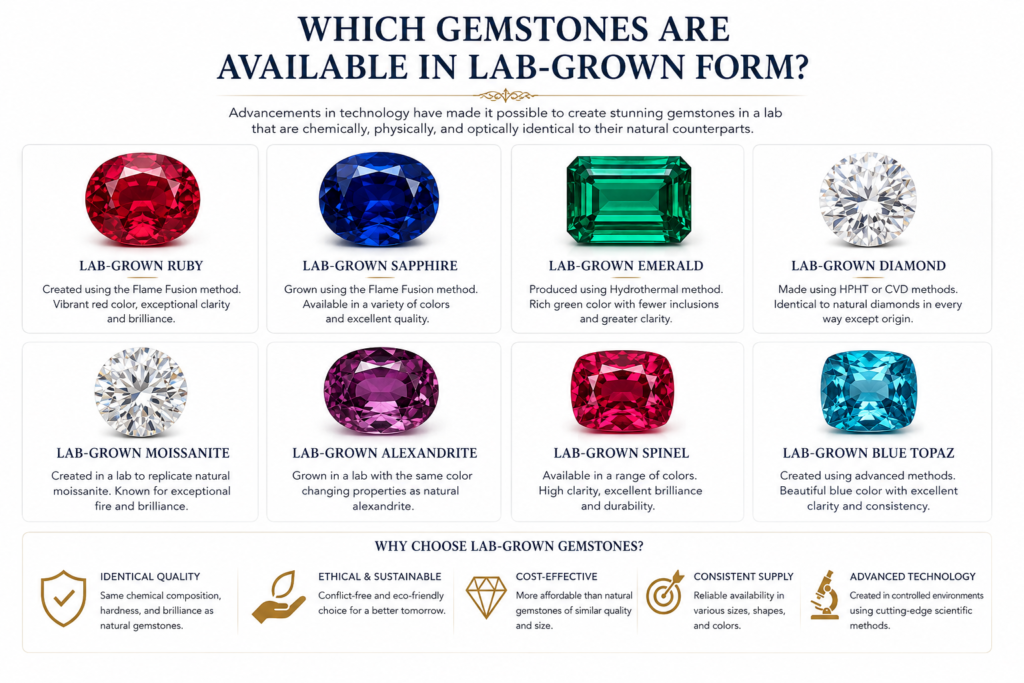
Not all gemstones are equally available in lab-grown versions. Understanding availability is critical for collection planning:
Widely available in lab-grown:
Ruby, blue sapphire, pink sapphire, emerald, alexandrite, spinel, moissanite, lab-grown diamond
Partially available:
Created opal exists but behaves differently from natural opal — the play of color is less complex and buyers familiar with natural opal can distinguish them
Primarily or exclusively natural:
Turquoise, labradorite, moonstone, malachite, Ethiopian opal, coral, larimar, moldavite, chrysocolla — these remain natural-only categories with no true lab-grown equivalent
B2B implication: If your brand aesthetic centers on boho, spiritual, or artisan gemstones — turquoise, moonstone, labradorite, Ethiopian opal — you are working with natural stones regardless of your preference. Lab-grown availability is concentrated in the classic precious stone categories.
What Does Your Target Market Want?
Consumer attitudes toward natural vs. lab-grown gemstones vary significantly by market, demographic, and price point:
USA Market
Strong and growing acceptance of lab-grown — particularly for sapphires, rubies, and emeralds. Price transparency is valued. Lab-grown’s lower price point is a significant selling advantage for brands targeting the $50–$200 retail segment. Sustainability messaging resonates with millennial and Gen Z buyers.
UK and European Markets
Growing acceptance, but natural gemstones retain stronger premium positioning. Ethical sourcing credentials matter for both categories — conflict-free natural stones and clean-energy lab-grown production. The premium segment strongly prefers natural.
Australian Market
Fast-growing lab-grown acceptance, particularly among younger buyers. Price-value equation is the primary driver. Sustainability credentials are increasingly important.
Middle Eastern and Asian Markets
Strong cultural preference for natural gemstones — rarity, provenance, and natural origin carry significant value. Lab-grown adoption is slower here. Brands targeting these markets should default to natural unless specifically catering to a price-sensitive segment.
Independent and Artisan Markets
Natural gemstones are the default — the unique, one-of-a-kind character of natural stones is central to the artisan jewelry narrative. Lab-grown’s consistency can actually be a disadvantage in markets where customers prize uniqueness.
How to Build a B2B Sourcing Strategy
Option 1 — Natural Only
Best for: Premium brands, artisan jewelers, brands targeting Middle Eastern or Asian markets, brands built around gemstone rarity and provenance.
Strategy: Partner with a manufacturer who has direct access to natural gemstone markets — ideally based in Jaipur where stone sourcing and jewelry manufacturing are in the same ecosystem. Require conflict-free documentation and country-of-origin certificates for high-value stones.
Option 2 — Lab-Grown Only
Best for: Brands targeting the accessible luxury segment ($50–$150 retail), sustainability-focused brands, brands needing visual consistency across large runs of ruby, sapphire, or emerald jewelry.
Strategy: Confirm lab-grown disclosure on all documentation. Request growth method and energy sourcing information from your stone supplier. Ensure your manufacturer can certify stones as lab-grown on all export documents.
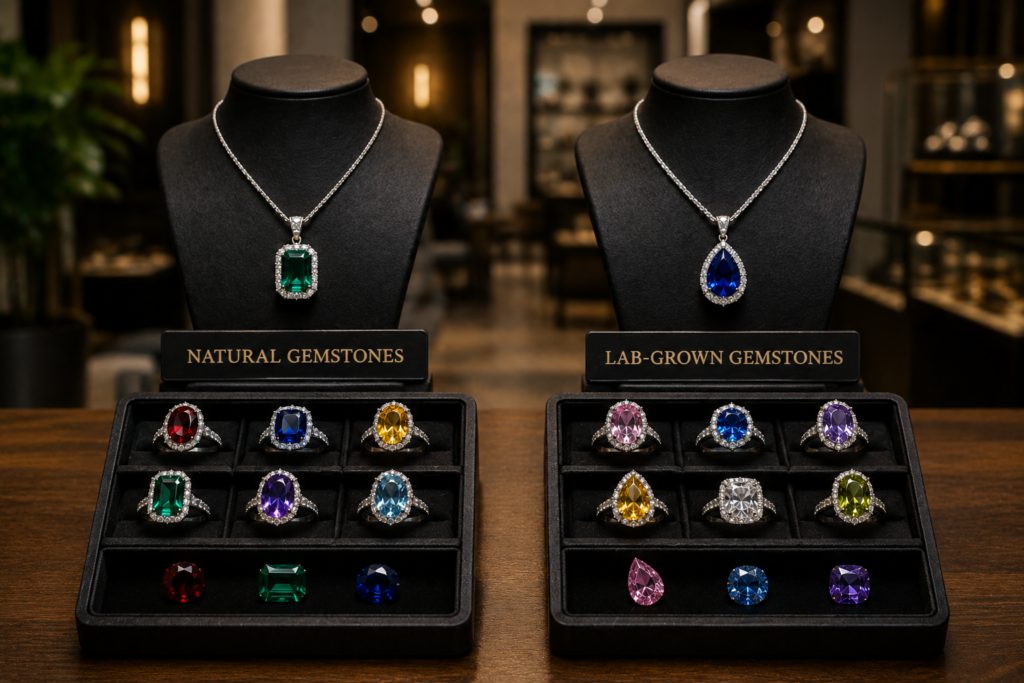
Option 3 — Both (Tiered Collection)
Best for: Brands wanting to serve multiple price points and customer segments with the same core designs.
Strategy: Offer natural stone versions at premium pricing and lab-grown versions at accessible pricing — same design, different stone origin, different retail price. This approach doubles your product range from a single design investment and allows customers to self-select based on budget and preference. Transparency about the difference between the two tiers builds trust rather than eroding it.
Gemstone Setting Options for B2B Buyers
Regardless of whether you choose natural or lab-grown stones, the setting method significantly affects both the appearance and durability of finished pieces:
Prong Setting: Stone held by metal prongs — maximum light exposure, classic look. Best for transparent stones where brilliance matters — sapphire, ruby, emerald.
Bezel Setting: Stone fully enclosed in a metal rim — very secure, modern look. Best for softer or more included stones where protection is important.
Pavé Setting: Multiple small stones set closely together — high-sparkle surface coverage. Best for diamonds, sapphires, and moissanite in fine jewelry applications.
Channel Setting: Stones set in a channel between two metal walls — clean, linear appearance. Best for matched stones in bands and bracelets.
Freeform / Organic Setting: Stone set to showcase its natural shape — particularly popular for freeform turquoise, labradorite, and Ethiopian opal in artisan jewelry.
At Eon Gems, our in-house gemstone bench handles all setting types in both 925 sterling silver and gold vermeil — with 250+ natural gemstone varieties available and lab-grown options on request.
Questions to Ask Your Gemstone Jewelry Manufacturer
Before placing a manufacturing order that includes gemstones, ask these questions:
1. Are stones natural or lab-grown — and is this documented on invoices?
Documentation is a legal requirement for export to most regulated markets.
2. For natural stones: can you provide country of origin and conflict-free certification?
Increasingly required by buyers in European and Australian markets.
3. For lab-grown: what growth method is used?
Hydrothermal, flame fusion, Czochralski — different methods produce different quality characteristics.
4. Are stones sourced in-house or from third-party suppliers?
In-house stone access — as with Jaipur-based manufacturers — means better quality control and pricing.
5. Can you provide matched stones for sets and pavé work?
Color and size matching across a production run requires careful selection — confirm this capability upfront.
6. What is your policy on stone quality inconsistency in a bulk order?
Understand how the manufacturer handles stones that fall outside the agreed quality specification.
Eon Gems — Natural and Lab-Grown Gemstone Jewelry Manufacturer in Jaipur
At Eon Gems, gemstone capability is one of our core manufacturing strengths. Based in Jaipur — the world’s largest colored gemstone trading hub — we have direct access to the broadest possible range of natural stones, supplemented by lab-grown options for brands that need them.
Our gemstone manufacturing capabilities include:
- 250+ natural gemstone varieties — sourced directly from Jaipur’s gem markets, conflict-free documentation available
- Lab-grown options — ruby, sapphire, emerald, moissanite, and alexandrite available on request
- All setting types — prong, bezel, pavé, channel, and freeform in-house
- Full integration with 925 sterling silver and gold vermeil manufacturing
- No MOQ — single prototype to large bulk production
- Complete export documentation — stone certificates, hallmark certificates, conflict-free documentation
Whether you are building a natural gemstone collection, exploring lab-grown options for a more accessible price point, or offering both in a tiered collection, our gemstone jewelry manufacturing capability is built to support your sourcing strategy end to end.
👉 Get a Free Quote from Eon Gems →
🔗 Gemstone Jewelry Manufacturing →
🔗 925 Sterling Silver Jewelry Manufacturing →
🔗 Gold Vermeil Jewelry Manufacturing →
Final Thoughts
The natural vs. lab-grown gemstone debate is not going away — and for B2B buyers, it should not be treated as a binary choice. The smartest brands in 2026 are making deliberate, market-informed decisions about which stones serve which customer segments — and sourcing accordingly.
Natural gemstones remain the gold standard for premium positioning, collector appeal, and markets where provenance matters. Lab-grown gemstones offer compelling economics, visual consistency, and sustainability credentials for brands targeting the accessible luxury segment.
The key is clarity — about what you are sourcing, how you are disclosing it, and why it is the right choice for your brand and your customer.